
Most swimmers think about swimming as pulling themselves through the water.
That sounds logical. After all, your arms are moving, you’re applying effort, and you can feel resistance against your hands.
But from a biomechanics perspective, that’s not actually what the best swimmers are doing.
Elite swimmers are not pulling water backwards. They are anchoring their hand and forearm in the water and driving their body past that point.
It’s a small shift in thinking, but it changes almost everything about how you understand swim technique.
The idea is known as the paddle concept – and once you understand it, many of the common mistakes swimmers make suddenly become much easier to identify and fix.
Think about a kayak paddle
Imagine sitting in a kayak.
You reach forward, plant the paddle in the water, and pull.
If you do it correctly, the paddle blade doesn’t move much at all. Instead, the kayak moves forward past the paddle.
The paddle acts like an anchor point.
There’s another detail worth mentioning here. When a kayaker does this correctly, the paddle blade exits the water at almost the same point it entered – because the water barely moved. The boat moved. That’s the whole game.
Swimming works in a very similar way.
Your hand and forearm become the “paddle”. Once they enter the water and set up in the right position, they should hold water firmly enough that your body can move forward past them.
That’s the goal.
Not to spin your arms faster.
Not to churn more water.
Not to “pull harder”.
The goal is to create an effective anchor in the water and move your body past it efficiently.
Why hand position matters so much
A kayak paddle only works when the blade is facing the correct direction.
Angle it the wrong way and it slips through the water. You still use energy, but very little of it helps move the boat forward.
It’s the same in swimming.
If your hand presses downward instead of backward, force is being directed toward the bottom of the pool instead of behind you.
If your elbow drops, you lose surface area and the paddle becomes weaker.
If your wrist collapses or your hand rolls sideways, water slips around the paddle instead of being held.
You can still feel resistance in all of these situations. In fact, some of them can even feel powerful.
But resistance alone does not equal propulsion.
This is one of the most important concepts in swimming biomechanics:
Effort and effectiveness are not the same thing.
A swimmer can work extremely hard while still wasting a large percentage of their force.
There’s one more thing that often gets overlooked here: timing.
Even if your hand and forearm are in the right position, if you start driving your body before the anchor is properly set, the paddle has nothing to push against. The anchor needs to be established first. The body drive follows.
Getting the position right matters. Getting the timing right is what makes it work.
Your forearm matters just as much as your hand
Many swimmers think only about their hand during the catch and pull phase.
But your forearm is a huge part of the paddle.
When coaches talk about an “early vertical forearm”, they are really talking about increasing the size and position of the paddle surface.
A good catch creates a larger surface area behind the water. That gives the swimmer more ability to hold water while the body travels forward.
A dropped elbow reduces that surface area dramatically.
This is why elite swimmers often look like they are “holding” the water rather than slipping through it.
Their paddle stays connected.
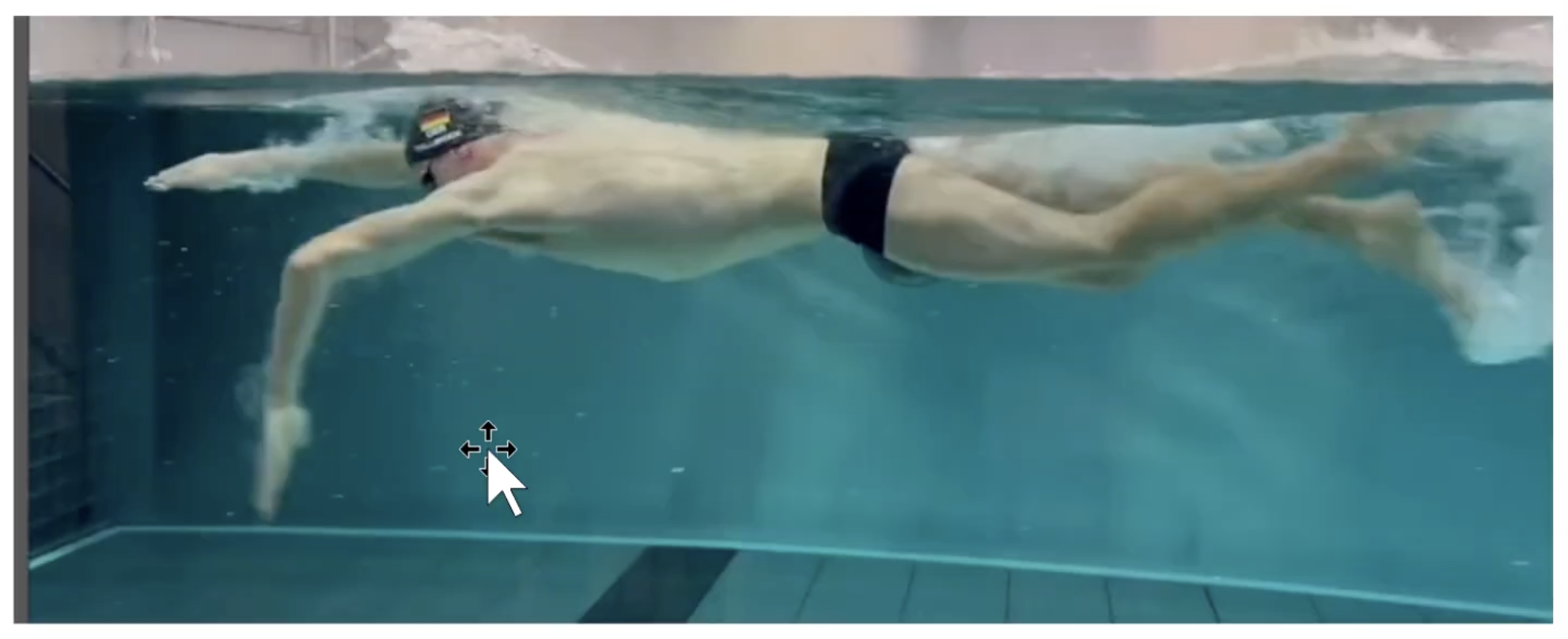 Florian Wellbrock establishing the anchor – positioning the hand and forearm to hold the water before driving his body forward.
The easiest way to understand good technique
There’s a very simple way to think about whether your paddle is working properly.
Watch where your hand enters the water. Then notice where it exits relative to the pool.

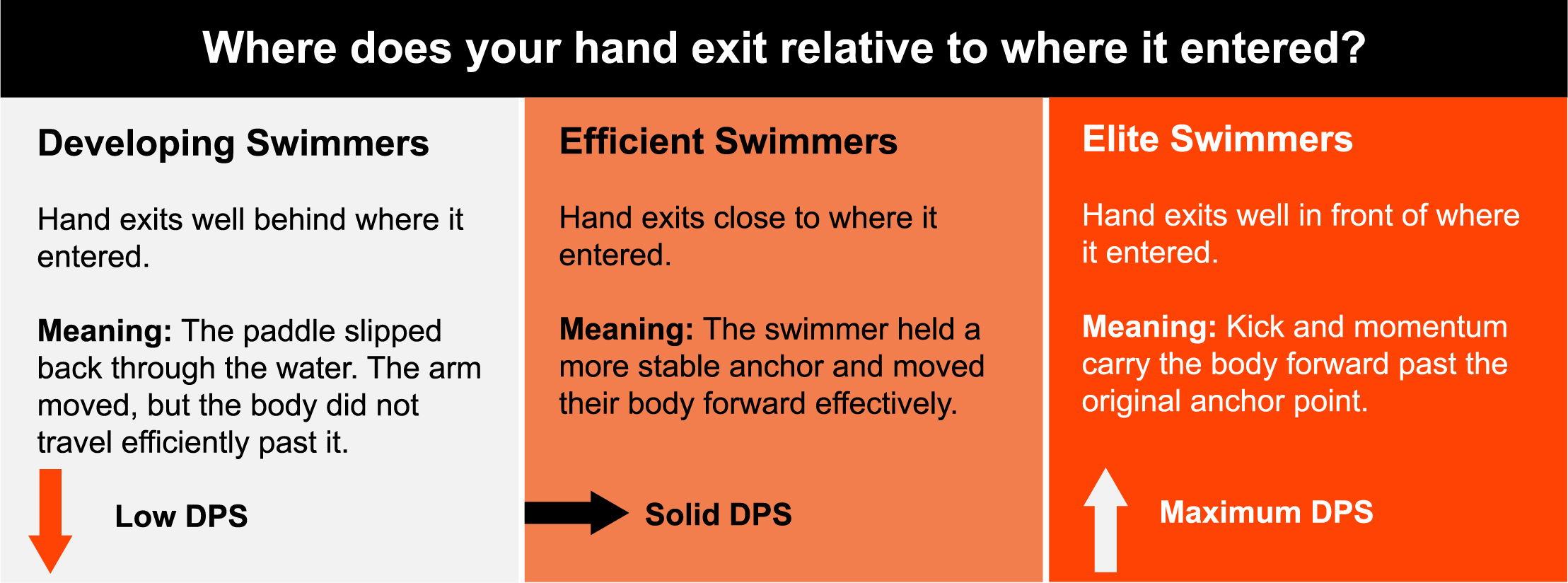
For the hand to exit ahead of where it entered sounds impossible at first. But think about what’s actually happening.
The hand enters and anchors. The body drives forward. By the time the stroke finishes, the swimmer has travelled so far past that anchor point that the original entry position is now behind them. The hand appears to move forward relative to the pool – not because the arm travelled forward, but because the body travelled so effectively past the paddle.
That’s what a powerful kick and genuine body momentum produce. It’s also why elite swimmers can look almost unhurried in the water while covering huge distance with each stroke.
You can’t hide from your Distance Per Stroke
One of the clearest indicators of swimming efficiency is Distance Per Stroke (DPS).
DPS measures how far you travel with each stroke cycle.
Higher DPS usually means:
- better connection with the water
- a stronger anchor
- less slippage
- more efficient propulsion
Lower DPS often means:
- force is being directed incorrectly
- the paddle is slipping
- energy is being wasted
- stroke mechanics are breaking down
This is why simply increasing stroke rate is not always the answer.
Spinning the arms faster can sometimes hide technical inefficiencies instead of solving them.
There’s a real trade-off here that’s worth understanding. A swimmer can increase stroke rate and complete a length faster – but if DPS drops significantly in the process, they are working harder to produce a result that better technique would deliver more economically. More effort, less return.
The goal is a high DPS that holds up under pressure. That’s where sustainable speed comes from.
Why poor technique is hard to feel
One of the biggest challenges in swimming is that the water gives confusing feedback.
Pressing downward can feel strong.
Slipping through the water can feel fast.
A high stroke rate can feel powerful.
But what you feel is not always what’s really happening biomechanically.
Most swimmers cannot accurately tell:
- how much force is going downward instead of backward
- whether one hand is producing more propulsion than the other
- how much their paddle slips during fatigue
- whether their catch position changes under pressure
That’s why objective feedback matters.
Video can help. Coaching helps enormously. But measuring force direction and movement patterns provides another layer of understanding that the swimmer simply cannot feel on their own.
What does that actually look like in practice?
When data shows a large percentage of force being directed downward instead of backward, the paddle is pushing at the pool floor.
When there’s a meaningful difference in propulsion between the left and right hands, one paddle is holding water better than the other.
When force builds before catch is established, the swimmer is creating resistance before the paddle is set.
The data doesn’t describe what a swimmer looks like. It describes what their paddle is actually doing – which is the only thing that determines how far each stroke carries them.
The role of biomechanics in improvement
Biomechanics is simply the science of how the body moves and produces force.
In swimming, biomechanics helps answer questions like:
- Is force being directed in the right direction?
- Is the swimmer holding water effectively?
- Where is energy being wasted?
- Does technique change when fatigue sets in?
- Is one side stronger or more effective than the other?
These are difficult things to judge purely by eye, especially underwater and at speed.
This is why high-level swimming is increasingly moving toward objective measurement and analysis.
Not to replace coaching.
Not to replace feel.
But to support better decision making.
The goal is not more data for the sake of data.
The goal is understanding why a swimmer is moving the way they are, and identifying simple changes that can create meaningful improvements in efficiency and speed.
Every technical error is really a paddle problem
Most swim technique issues can ultimately be traced back to one thing:
The paddle is either anchoring effectively, or it’s slipping.
That might look like:
- pressing downward at the catch
- dropping the elbow
- rolling the hand sideways mid-stroke
- losing pressure under fatigue
- asymmetry between left and right sides
At eo, we’ve spent years analysing many tens of thousands of swim sessions from elite and competitive swimmers and triathletes and we repeatedly saw the same patterns appear.
That became the foundation of the eo SwimBETTER Technical Error Index – 12 measurable freestyle errors that reduce propulsion, waste energy, or limit distance per stroke.
In future articles, we’ll break down each of these errors individually:
- what causes them
- how they impact propulsion
- why swimmers often can’t feel them
- and how to improve them
Once you understand the paddle concept, technique stops becoming a collection of disconnected coaching cues – and starts to become much easier to understand.
Understand the paddle. Fix the errors. Watch the distance per stroke grow and times come down.
Download the eo SwimBETTER Technical Error Index HERE. 12 measurable freestyle errors, what causes them, and what to do about each one.
Related topics: swimming biomechanics; freestyle technique fundamentals; distance per stroke swimming; paddle concept swimming; hand position freestyle; swimming catch mechanics; eo SwimBETTER; swimming efficiency; propulsive force swimming; DPS swimming; swim technique for beginners; swimming force measurement; kayak paddle analogy swimming; how to swim faster; swimming stroke analysis.
Back