
Understanding Excessive Lateral Force
By Jaimie Fuller
The pool runs from one end to the other.
Forward is the only direction that matters.
And yet a significant amount of the force many swimmers generate goes sideways.
Not backward. Not downward. Sideways. Left or right. Force that crosses the pool rather than driving down it – effort that costs the swimmer energy, disrupts their line, and contributes very little to forward speed.
This is Excessive Lateral Force – Error #9 in the eo SwimBETTER Technical Error Index. It is one of the most purely wasteful errors in the index: unlike downward force, which at least plays a small transitional role in the catch, lateral force in freestyle has virtually no positive function whatsoever. Every percentage point of lateral force is effort that did not move the swimmer forward.
And like most of the errors in this series, it is almost impossible to feel from inside the stroke – which is precisely why measuring it changes everything.
What is Excessive Lateral Force?
In swimming, force is generated in multiple directions simultaneously with every stroke. The goal is to maximise the propulsive component – force directed backward, driving the body forward – while minimising wasted components in other directions.
Lateral force is the component directed sideways – to the left or right. Some small amount of lateral force is an unavoidable consequence of the sweeping arc of the freestyle pull. The hand moves outward and then inward during the pull phase, and this path generates minor lateral force vectors as a natural by-product. In an efficient stroke, these remain small and balanced.
Excessive Lateral Force occurs when these sideways vectors grow beyond the acceptable range – when a meaningful portion of every stroke's effort is being directed sideways rather than backward. The Force Field chart makes this visible immediately: the leftward and rightward bars extending well beyond their target, consuming force that should be propulsive.


The target is less than 4% lateral force to both the left and right in sprint and distance freestyle. When values exceed this – particularly when they climb to 10%, 12%, or higher as we frequently see in eo SwimBETTER data – a significant fraction of every stroke's force output is being spent pushing the water sideways instead of backward.
In eo SwimBETTER, Excessive Lateral Force appears in the Force Field chart as:
- leftward and/or rightward bars extending well beyond 4% of total force
- the Force Field shape spreading horizontally instead of pointing cleanly rearward
- will be accompanied by a reduced propulsive percentage – force going sideways rather than forward
- may be asymmetric – one side generating more lateral force than the other
Why does it happen?
Excessive lateral force has two primary causes – and a third pattern where both appear together. Understanding which is present is essential, because each requires a different correction.
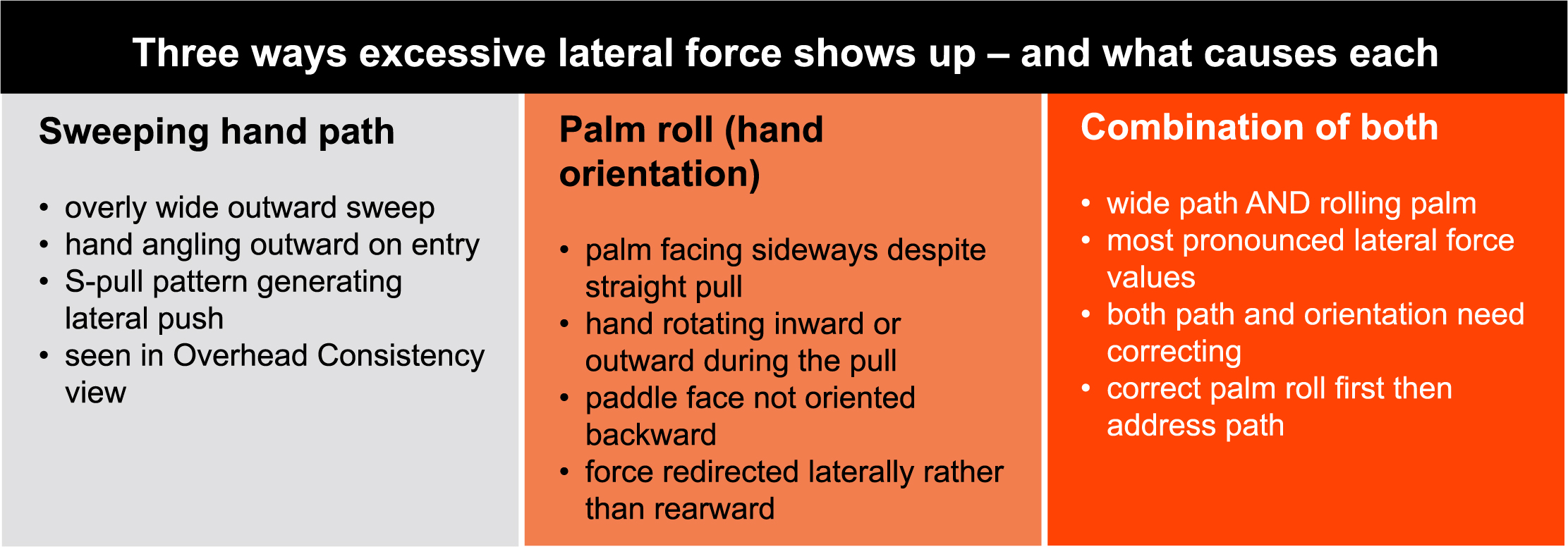

Cause 1: An overly sweeping hand path
The freestyle pull naturally involves some lateral movement – the hand sweeps outward during the early pull and inward during the push phase. This is normal and expected. The problem arises when this sweep becomes exaggerated – when the hand travels too wide on the outward sweep, or angles too aggressively inward on the return.
An overly wide hand path generates excessive lateral force because the hand is moving significantly sideways through the water. Even with correct palm orientation, a hand travelling a wide, sweeping arc creates substantial force in the direction of movement – and if that movement is sideways, the force is sideways.
This is visible in the Overhead view of the Consistency chart – the hand path extending wide of the body centreline significantly further than an efficient pull requires. The correction is to tighten the path: less outward sweep on the early pull, a more direct inward drive without an excessive lateral arc.
Cause 2: Incorrect palm roll – hand rotation during the pull
Palm roll refers to the hand rotating during the pull so that the palm faces inward or outward rather than backward. When this rotation is excessive, the paddle face is no longer oriented toward the back of the pool. Instead of pushing water backward, it pushes water sideways.
This is the more subtle and more common cause of excessive lateral force. A swimmer can have a perfectly reasonable hand path – neither too wide nor too aggressive in its sweep – and still generate significant lateral force simply because the palm is tilted sideways rather than facing backward. The path looks correct. The orientation is not. And without force measurement, it is essentially invisible.
Incorrect palm roll often develops as a compensation pattern. Swimmers who have been coached to pull with a high elbow or to avoid crossing the centreline sometimes overcorrect – rotating the wrist outward to keep the hand clear of the body centreline, inadvertently turning the paddle face sideways. The result is a mechanically reasonable-looking pull that is generating significant lateral force due to the hand rolling away from the backward-facing position.
A straight pull path and a rolling palm are not the same thing. The hand can travel a correct route through the water while the paddle face points entirely the wrong way.
The relationship with Error #8
Error #8 (Mid-Stroke Propulsion Loss) and Error #9 share a mechanical relationship worth understanding – because they often appear together in the data, and addressing one can reduce the other.
In Error #8, the lateral force line crossing below zero mid-stroke was the signal that the hand was rolling inward excessively, causing the double peak. That excessive hand roll is, by definition, also generating lateral force – the paddle face is tilting sideways at that moment.
When excessive lateral force appears in the Force Field chart alongside a double peak in the Force vs Time chart, the two errors are likely sharing a common cause: a hand path that sweeps too wide with a palm that rolls through the transition. The Force Field chart averages the lateral force across all strokes; the Force vs Time chart shows when it spikes. Read together, they provide a much clearer picture.
When Error #8 and Error #9 appear together:
Address hand orientation and palm roll first – this typically reduces both the double peak (Error #8) and the lateral force values (Error #9) simultaneously. If lateral force remains elevated after the double has peak resolved, the remaining cause is likely the hand path shape rather than the palm orientation. Use the Hand Path & Force chart Overhead view to assess whether the sweep pattern needs tightening after palm roll has been corrected.
Why it matters
Pure wasted energy – no positive function
Unlike downward force – which has a small, transitional role in the catch phase – lateral force in freestyle has almost no beneficial function. The pool does not require the swimmer to push water sideways. There is no speed benefit, no body position benefit, no stability benefit. Lateral force is purely and entirely wasted effort, expended on every stroke with zero return.
When lateral force values are running at 10% or higher on each side, that is 20% or more of every stroke's total effort going in a direction that does nothing useful. In a 1500m freestyle event with over 1,000 strokes, the accumulated waste is enormous. Even at lower values – 5-7% on each side – the cumulative cost across a race or training session is meaningful.
Increased energy cost, reduced sustainable pace
Wasted force means wasted energy. A swimmer generating excessive lateral force is spending more metabolic energy per metre than they need to – because a portion of every muscular contraction is producing force that doesn't move them forward. This directly limits their sustainable pace at any given effort level.
Reducing lateral force doesn't just improve efficiency in theory – it directly reduces the energy cost of a given speed, which means either swimming faster at the same effort or holding the same speed for longer. Both outcomes are significant for competitive performance.
Rotational and tracking disruption
Asymmetric lateral force – where one side generates more sideways force than the other – creates a rotational imbalance in the stroke. The body is being pushed laterally on one side more than the other with every stroke cycle. In the pool, this shows up as lane drift. In open water, it causes the swimmer to consistently curve off course – a source of significant additional distance in race conditions.
Even symmetric excessive lateral force disrupts tracking. Left and right pushes on alternating strokes create an S-shaped path through the water rather than a straight line – adding distance to every lap without the swimmer being aware of it.
The S-pull debate
Some older coaching traditions taught the S-pull – a deliberately wide, sweeping hand path – as the optimal freestyle technique. The premise was that a longer path through the water produced more propulsion. Modern biomechanical research, and the force measurement data from eo SwimBETTER, does not support this. A wider path generates more lateral force, not more propulsion. The most efficient pull paths are relatively direct – enough sweep to maintain propulsive continuity through the stroke, but not so wide as to push significant force sideways.
What to do about it
Step 1: Confirm the scale and pattern in the Force Field
Check the lateral force values on both sides in the Force Field chart. Are both sides elevated, or predominantly one? Is the asymmetry significant – suggesting a breathing-side contribution – or is the excess roughly equal left and right? The pattern informs the priority: asymmetric excessive lateral force often has a breathing or hand path asymmetry component (linking back to Errors #1 and #7).
Step 2: Check the Force vs Time chart for a double peak
If a double peak is also present (Error #8), address palm orientation and roll first – this is the shared mechanical cause. Correcting the hand roll at the transition point will reduce both the double peak and the lateral force simultaneously. Reassess lateral force values after Error #8 has been addressed before targeting the path shape separately.
Step 3: Address palm orientation and roll
The correction for roll-related lateral force is to ensure the palm faces broadly backward throughout the pull – not tilted inward or outward due to hand rotation. A useful reference is the position of the fingers: in a correctly oriented pull, the fingertips point broadly downward and the knuckles point broadly backward. If the thumb side of the hand is leading – rotating outward – the palm is rolling to face sideways and lateral force will be elevated.
Slow drills with deliberate focus on palm orientation – single-arm swimming, catch-up with attention to hand angle – allow the swimmer to develop the feel for correct orientation before building tempo.
Step 4: Tighten the hand path if the sweep is too wide
If lateral force remains elevated after palm orientation has been corrected, the hand path itself needs attention. Use the Overhead view of the Consistency chart to assess how wide the outward sweep is travelling. A path that extends well beyond shoulder width on the outward sweep, or one that crosses the centreline aggressively on the inward drive, is generating unnecessary lateral force from the path shape alone.
The correction is not to eliminate the sweep – some lateral movement is natural and necessary – but to keep it within an efficient range. The hand should travel far enough outward to set up a mechanically sound pull without sweeping so wide that significant force is directed sideways. The Consistency chart provides the spatial reference to make this adjustment with precision.
Step 5: Correct palm roll and path before increasing tempo
As with all force direction errors, the sequence matters. Get the orientation right first, at reduced stroke rate. Confirm in the Force Field chart that lateral force values are moving toward target. Then gradually increase tempo, confirming at each stage that the improvement holds. Attempting to correct lateral force at race pace is rarely effective – the movement pattern is too automated for conscious correction to take hold under speed.
The bigger picture
Excessive Lateral Force is the third purely directional error in the Technical Error Index, following downward force (Errors #3 and #4) and the mid-stroke propulsion loss caused by rolling (Error #8). Each of these errors represents a different way the paddle can be misdirected – down, sideways during the transition, or sideways throughout the pull.
Error #9 is notable for one specific reason: it has no silver lining. Downward force has a transitional role. Even Error #8's double peak produces some propulsion on either side of the valley. But lateral force in freestyle produces nothing useful. It is 100% waste – effort expended with no forward return.
The pool runs forward. Every Newton of force that goes sideways is a Newton that did not go backward. And in competitive swimming, that difference is everything.
The Force Field chart makes lateral force visible in a way nothing else can. And once it is visible – once a swimmer or coach can see that 12% of every stroke is going sideways – the motivation to correct it is immediate. The physics are simple. The measurement is clear. The improvement, when it comes, shows up directly in the data as lateral values dropping and propulsive values rising.
The paddle concept again: hold the water, drive the body forward. Any force that isn't doing that needs to be reclaimed. Lateral force is the most straightforward reclamation in the Technical Error Index – because once it is identified and corrected, every bit of energy it was consuming becomes propulsion.
Find it in the Force Field.
Correct the palm roll. Tighten the path.
Reclaim the sideways force.
Put it where it belongs – backward.
How much of your stroke is going sideways?
Excessive Lateral Force is just one of 12 measurable freestyle errors identified through eo SwimBETTER data.
Download the full Technical Error Index to learn:
- the hidden technique patterns slowing swimmers down
- why they happen
- how to identify them in the data
- and what the evidence says about fixing them
Related topics: excessive lateral force swimming; freestyle palm roll correction; hand path freestyle; S-pull swimming; palm orientation freestyle; eo SwimBETTER; Force Field chart swimming; swimming force measurement; freestyle propulsion efficiency; swimming biomechanics; swim coaching data; open water swimming straight line; lateral force; sideways force swimming; swimming force direction; freestyle efficiency loss; swimming palm orientation; swimming pull path; wasted force swimming
Back