
Understanding Mid-Stroke Propulsion Loss (Double Peaks)
By Jaimie Fuller
A good freestyle pull should build continuously.
The catch establishes the anchor. The pull accelerates. The push drives the body forward.
One continuous arc of propulsion from entry to exit.
But for a significant number of swimmers, something interrupts that arc. Right in the middle of the pull – at the point where the hand transitions from sweeping outward to driving inward – propulsion drops. Sometimes briefly. Sometimes dramatically. And then it picks up again on the other side of the interruption.
In the Force vs Time chart, this produces one of the most recognisable data signatures in swimming: the double peak. Instead of a single, continuous propulsive arc on each stroke, you see two separate peaks with a valley between them – a clear dip in propulsive force right in the middle of what should be the most powerful phase of the stroke.
This is Mid-Stroke Propulsion Loss – Error #8 in the eo SwimBETTER Technical Error Index. It is a subtle fault that is essentially invisible to the naked eye, yet measurably costs the swimmer speed on every single stroke.
What is Mid-Stroke Propulsion Loss?
In an efficient freestyle pull, propulsive force builds through the stroke cycle and peaks as the hand drives through the power phase. In a clean, effective stroke the Force vs Time chart shows a single smooth peak on each stroke – rising as the pull develops, reaching maximum as the hand drives through the water, and falling as the hand exits.
Mid-Stroke Propulsion Loss occurs when this continuous arc is interrupted. At a specific point in the pull – typically as the hand transitions from moving outward and backward to sweeping inward toward the centreline – propulsive force drops off, then recovers. The result is two propulsive peaks per stroke separated by a distinct valley.
The double peak is the data fingerprint of this error. Once you know what you are looking for, it is unmistakable in the Force vs Time chart – and it is one of the clearest examples in the entire Technical Error Index of something that data reveals that observation simply cannot.
In eo SwimBETTER, Mid-Stroke Propulsion Loss appears across two charts:
Force vs Time
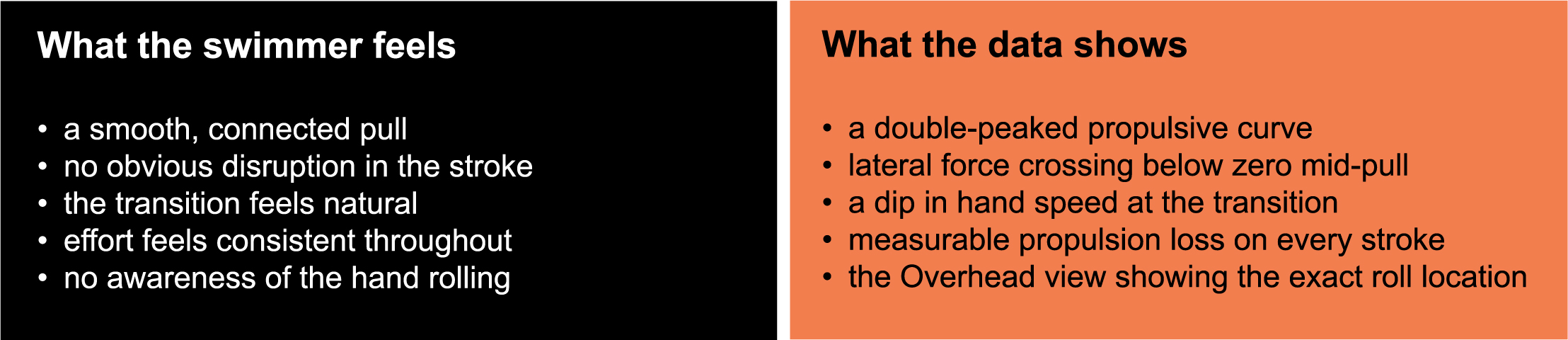
- a double-peaked propulsive curve on affected strokes, with a visible valley mid-pull
- the lateral force line (light blue) crossing below zero at the valley point, indicating the hand is rolling inward
- a corresponding dip in hand speed (green line) at the same moment
Hand Path & Force
- the Overhead view shows the hand position at the transition point where the roll occurs
What's actually happening – reading the data
The double peak is the visible symptom. But the Force vs Time chart reveals more than just the peak shape – it shows the mechanical cause playing out in real time across three force lines simultaneously.
The key is the lateral force line – the light blue line (right hand) or orange line (left hand) in the Force vs Time chart. In a clean pull, this line can go above zero as the hand sweeps outward during the early pull phase, then returns below zero as the hand drives inward. When mid-stroke propulsion loss is present, the lateral force line goes significantly below zero – meaning the hand is no longer just slowing its outward sweep, it is actively rolling inward. And at precisely that moment, the propulsive force line (dark blue) drops, and hand speed (green) dips.
These three simultaneous signals tell a coherent story: the hand has rolled at the transition point, its effective paddle surface has tilted away from the propulsive direction, and the grip on the water has been momentarily lost. Propulsion drops not because the swimmer has stopped applying effort – but because the paddle has briefly stopped facing the right way.
The double peak is not two strokes. It is one stroke with a hole in the middle – a moment where the paddle turns away from the water and propulsion collapses.
Why does it happen?
Two primary causes account for the vast majority of double-peak patterns in eo SwimBETTER data. They often occur together – and in the most pronounced cases, both are contributing simultaneously.
1. Excessive hand roll at the transition point
As the hand completes the outward sweep of the pull and begins to move inward toward the centreline, many swimmers allow – or actively drive – the hand to rotate. The palm, which should remain facing broadly backward throughout the pull, rolls inward. The effective paddle surface tilts away from the propulsive direction.
This hand roll is the most direct cause of mid-stroke propulsion loss. The moment the palm stops facing backward, it stops producing propulsive force effectively – regardless of how much muscular effort is being applied. The hand is moving through the water, but the paddle has turned, and propulsion collapses.
The roll typically occurs at a very specific point in the stroke: at the outer edge of the hand path, just before the hand begins to move inward toward the centreline. This is the transition from the outward sweep to the inward drive – and it is the moment of maximum vulnerability for hand rotation. Using the time slider, the overhead view in the Hand Path and Force chart will show exactly where in the hand path the roll happens, allowing the correction to be targeted precisely.
2. Reduced hand velocity at the transition
The second cause is a loss of hand speed at the transition point. Even with correct hand orientation, if the hand decelerates significantly as it changes direction from outward to inward, the propulsive force drops – because propulsive force is closely related to hand velocity. A slower hand produces less propulsive force, even with a well-oriented paddle face.
This deceleration often occurs because the swimmer pauses or hesitates at the transition point – a brief moment of muscular disengagement as the arm reverses direction. The green hand speed line in the Force vs Time chart makes this visible: a dip in hand speed that coincides with the valley between the two propulsive peaks.
In practice, hand roll and velocity loss frequently occur together. The roll causes the swimmer to lose their feel for the water, which causes a hesitation, which causes a velocity drop, which compounds the propulsion loss. The data signature of both causes present simultaneously is a deeper, wider valley between the double peaks.
The double-peak fault sequence:
- Hand completes outward sweep and begins transition to inward drive
- Hand rotates – palm rolls inward, paddle face tilts
- Propulsive force drops as the paddle loses its backward orientation
- Hand velocity may also dip as the swimmer loses connection with the water
- Hand re-orients on the inward drive – propulsion recovers, producing the second peak
- Result: two propulsive peaks per stroke with a valley of lost propulsion between them
Why it matters
Propulsion is lost at the power phase
The mid-pull transition – the point where Error #8 occurs – is not a peripheral part of the stroke. It sits within the power phase, the portion of the pull where the swimmer should be generating maximum propulsive force. Losing propulsion at this point is the equivalent of an engine misfiring at maximum RPM – the worst moment for a breakdown to occur.
The valley between the two peaks represents real speed that the swimmer is not generating. Every stroke with a double peak is a stroke that produced less forward drive than it should have – and in a long race or a high-stroke-count training set, those accumulated losses are significant.
It is invisible from the pool deck
This is one of the defining characteristics of Error #8 – and one of the strongest arguments for data-driven coaching. The hand roll that causes mid-stroke propulsion loss is a small, fast movement that occurs deep in the pull phase. It lasts a fraction of a second. It produces no obvious visual signal from the pool deck. Video may not capture it clearly. And the swimmer cannot feel it – because the roll feels like a natural part of the stroke transition.
Without the Force vs Time chart, this error can persist for years in a swimmer's technique without ever being identified. With it, the double peak is immediately apparent, and the lateral force line shows exactly what is happening and when.
Compounding effect at higher stroke rates
At lower stroke rates, a swimmer may partially recover propulsion within the same stroke cycle – the second peak compensates somewhat for the valley. As stroke rate increases, there is less time within each cycle for this recovery. The double peak becomes proportionally more damaging at higher tempos, making Error #8 one of the errors that most limits a swimmers ability to translate higher stroke rates into faster speeds.

What to do about it
Step 1: Confirm and locate using the data
The Force vs Time chart confirms the double peak. The lateral force line confirms the hand roll – look for it crossing below zero at the valley point. The hand speed line confirms any velocity loss. And the Overhead view in the Hand Path and Force chart shows exactly where in the hand path the transition occurs – giving the coach a spatial reference for the correction.
Is the double peak present on one hand or both? Is it consistent on every stroke or does it appear only under fatigue? Is the valley shallow or deep? These details shape the intervention priority and the expected timeline for improvement.
Step 2: Reduce hand rotation at the transition
The primary correction target is the degree of hand roll as the stroke transitions from outward sweep to inward drive. The palm should remain facing broadly backward through this transition – not rolling inward as the hand changes direction. A useful coaching focus is to maintain the sensation of the palm pressing against water throughout the transition, rather than allowing the wrist to rotate and the palm to face the pool floor or the centreline.
The specific cue will vary by swimmer. Some respond well to focusing on keeping the thumb pointing down throughout the pull. Others respond to the image of maintaining a flat, backward-facing paddle through the transition. The goal in all cases is the same: reduce the rotation of the hand at the exact point where the Hand Path and Force chart shows the roll occurring.
Step 3: Maintain hand velocity through the transition
Alongside orientation, the swimmer should focus on maintaining – or accelerating – hand velocity through the transition rather than allowing a hesitation or pause. The inward drive of the pull should begin with momentum carried through from the outward sweep, not from a standing start after a brief pause.
A useful mental model is to think of the pull as a continuous acceleration from catch to exit – no pauses, no gear changes, just a smooth build of speed through the water. Drills that emphasise continuous hand movement – sculling variations, pull-buoy sets with deliberate pull focus – help embed this feel.
Step 4: Use the Overhead view to target the correction
The Overhead view in the Hand Path and Force chart shows where in the spatial hand path the transition occurs. This tells the coach exactly which part of the underwater pull needs attention – how far out, how deep, at what stage of the arc. This spatial information makes the correction much more precise than general technique cueing, because the coach can direct the swimmer's attention to a specific point in the stroke rather than a general phase.
Step 5: Work at reduced stroke rate, then build
As with all motor pattern corrections, the initial work should happen at a reduced stroke rate – slow enough for the swimmer to maintain conscious control of hand orientation through the transition. Once the double peak reduces or disappears at lower tempo – confirmed in the Force vs Time chart – stroke rate can be gradually increased, with data confirmation at each increment that the improvement is holding.
The bigger picture
Mid-Stroke Propulsion Loss is Error #8 in the Technical Error Index – sitting in the middle of the list, and in many ways representing the middle of the stroke. It is neither a catch error nor a finish error. It is a transition error – a failure to maintain propulsive continuity through the most dynamic phase of the pull.
What makes it particularly interesting from a coaching perspective is how specific the data is about where and why it occurs. The double peak tells you propulsion was lost. The lateral force line tells you the paddle rolled. The hand speed line tells you velocity dropped. And the Overhead view tells you exactly where in the stroke path it happened.
That level of specificity is only possible with force measurement. Video can show the stroke. Observation can note the rhythm. But neither can identify a momentary hand roll at a specific point in the pull phase – or confirm that the correction has actually eliminated it.
Every stroke should be one continuous arc of propulsion. When the data shows two peaks instead of one, it is telling you exactly where that arc is breaking – and giving you everything you need to repair it.
The double peak is one of the most correctable errors in the Technical Error Index, precisely because the data is so specific about its cause and location. Find the roll. Reduce it. Maintain the velocity. And watch the two peaks merge back into the continuous arc they were always meant to be.
Find the valley in the data.
Find the roll in the stroke.
Remove the hesitation.
Restore the arc.
Is there a hole in the middle of your pull?
Mid-Stroke Propulsion Loss is just one of 12 measurable freestyle errors identified through eo SwimBETTER data.
Download the full Technical Error Index to learn:
- the hidden technique patterns slowing swimmers down
- why they happen
- how to identify them in the data
- and what the evidence says about fixing them
Related topics: mid stroke propulsion loss swimming; double peak freestyle; hand roll swimming; freestyle pull phase; swim stroke transition; eo SwimBETTER; Force vs Time swimming; swimming force measurement; freestyle technique analysis; hand velocity swimming; propulsive efficiency; freestyle double peak; propulsion dip swimming; swimming hand roll; losing propulsion mid pull; freestyle pull interruption; swim stroke propulsion loss
Back