
Understanding Hand Path Asymmetry
By Jaimie Fuller
The left hand enters at one depth.
The right hand enters at another.
One pulls wide. The other pulls narrow.
One drives deep through the water. The other barely scratches the surface.
To the swimmer, the stroke feels balanced. Both arms are working. Both sides are rotating. The effort feels even.
But overlay the hand paths of left and right on the same chart, and a completely different picture emerges. Two hands travelling through the water on two distinctly different routes – different depths, different widths, different shapes. The same swimmer, the same stroke, and yet the two paddles are doing entirely different things on every cycle.
This is Hand Path Asymmetry – Error #7 in the eo SwimBETTER Technical Error Index. It is one of the clearest visual signals in swimming data that something is structurally different between the two sides of the stroke. And like most technique errors, it is almost impossible to detect without measurement.
What is Hand Path Asymmetry?
Hand Path Asymmetry occurs when the left and right hands follow measurably different spatial paths through the water on each stroke cycle. It is distinct from stroke-to-stroke inconsistency (Error #6), which is about how much each hand's path varies from one cycle to the next. Error #7 is about the structural difference between the left path and the right path – even if both paths are individually consistent.
In eo SwimBETTER, this is revealed by the Consistency chart when left- and right-hand paths are displayed together. A symmetrical swimmer will show left and right path clusters that closely mirror each other across all three views – Side On, Overhead, and Head On. An asymmetric swimmer will show clusters that sit in distinctly different positions or follow clearly different shapes.
Hand Path Asymmetry appears in the eo SwimBETTER Consistency chart as:
- different depth profiles left vs right in the Side On view – one hand pulling deeper than the other
- different lateral positioning in the Overhead view – one hand pulling wider or crossing the centreline more than the other
- different entry and exit shapes in the Head On view – the two hands following different arcs through the water
- the asymmetry is usually consistent stroke to stroke – both clusters may be tight individually, but they sit in different places
Error #6 vs Error #7 – an important distinction
These two errors both live in the Consistency chart, but they tell different stories and require different responses.
Error #6 (Hand Position Inconsistency) is about variability within each hand – the same hand taking a different path on each stroke. The cluster for each hand is wide and scattered. The fix is to reduce tempo and rebuild the motor pattern through correct repetition.
Error #7 (Hand Path Asymmetry) is about the structural difference between hands – each hand may have a reasonably tight cluster, but the two clusters sit in different places. The fix is to understand why the two sides are different – and that requires a different diagnostic approach entirely.
Error #6 asks: why is this hand inconsistent? Error #7 asks: why are these two hands different from each other?
Why does it happen?
Hand Path Asymmetry almost always has a cause on one specific side – the side that deviates from the more natural, unloaded path. Understanding the cause is essential before any intervention, because the correction depends entirely on what is creating the asymmetry.

Breathing – the most common cause by far
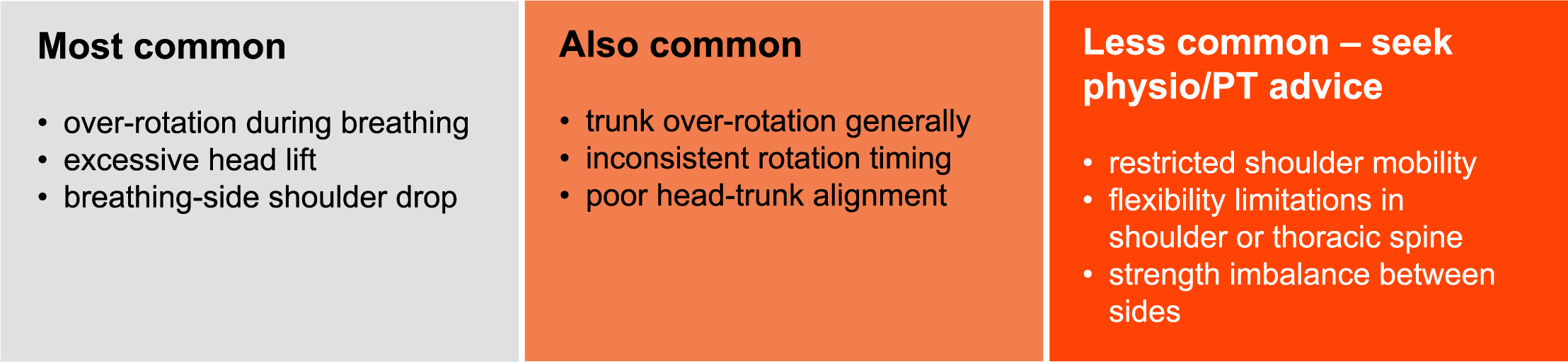
The vast majority of hand path asymmetry cases in eo SwimBETTER data are linked to breathing technique. When a swimmer breathes to one side, the mechanics of that breath – the head rotation, the shoulder drop, the body tilt – affect the arm on the breathing side more than the non-breathing side. The breathing-side arm often pulls deeper, wider, or with a different arc because the body it is attached to is in a different position every time a breath is taken.
The tell in the data is straightforward: the asymmetry tracks the breathing side. The hand path on the preferred breathing side looks different to the opposite side – and the difference tends to be consistent, appearing on every breathing stroke rather than randomly.
This matters enormously for intervention. A breathing-related hand path asymmetry is not a hand problem. It is a breathing problem that expresses itself in hand path data. Coaching the hand path directly – without addressing the breathing mechanics that are causing the asymmetry – will produce limited and temporary results at best.
Excessive head lift
A specific breathing-related pattern worth calling out separately. When a swimmer lifts their head rather than rotating it to breathe, the mechanical disruption to shoulder and arm position is more severe than with a rotation-based breath. The shoulder on the breathing side drops significantly, the arm follows, and the hand path on that side shows a pronounced depth asymmetry – diving noticeably deeper on head-lift breathing strokes than on non-breathing strokes.
Trunk over-rotation
Some swimmers rotate their body excessively during the stroke cycle — beyond what is needed for effective shoulder extension and propulsive force. When this over-rotation is asymmetric – more pronounced on one side than the other – it creates a body position difference between left and right strokes that drives a corresponding difference in hand path. The arm on the over-rotating side travels a different arc because the shoulder it is attached to has moved further than on the opposite side.
Flexibility, mobility, or strength asymmetry
In a minority of cases – but an important one – hand path asymmetry reflects a physical difference between the two sides rather than a technique or breathing issue. Restricted shoulder mobility, thoracic spine stiffness, or a strength imbalance between sides can all cause one arm to follow a structurally different path because it physically cannot replicate the movement on the opposite side.
This is where eo SwimBETTER's role as a diagnostic tool extends beyond technique coaching into physical preparation. If hand path asymmetry persists after breathing mechanics have been addressed and trunk control has been improved, the possibility of a physical limitation should be investigated. This is not territory for a swimming coach alone – a physiotherapist or physical therapist assessment is the appropriate next step.
Why it matters
Asymmetric propulsion creates rotational imbalance
When the two hands are following different paths through the water, they are anchoring at different points and driving the body from different positions on each stroke. The propulsive contribution of each side becomes structurally unequal – not just because of force differences (Error #1) but because of geometric differences in where and how each paddle is applied.
This creates a rotational imbalance in the stroke cycle. The body tends to drift or pull toward the side with the deeper or wider hand path, disrupting straight-line tracking and requiring constant compensatory effort to maintain course. In open water, this manifests as drifting off line. In the pool, it shows up as inconsistent turn approach angles and lane position drift.
Inconsistent propulsive vectors
Recall the paddle concept: the hand and forearm anchor in the water and the body drives past that anchor point. When the left anchor is in a different position to the right anchor, the body is being driven forward from two different geometric points on alternating strokes. The propulsive vectors are different – the force is driving the body forward and slightly in different directions on left and right strokes. Over distance, this inconsistency creates rhythmic disruption and accumulated inefficiency.
Injury risk – particularly when physical causes are present
When hand path asymmetry is caused by a physical limitation – restricted mobility, structural stiffness, strength imbalance – the swimmer is likely compensating on every stroke. Compensation patterns, repeated over months and years of training, place repeated atypical loads on joints and soft tissues. Shoulder impingement, rotator cuff strain, and cervical strain are all more common in swimmers with persistent asymmetric mechanics.
The data can identify the asymmetry long before an injury occurs. This is one of the most valuable preventive applications of eo SwimBETTER – flagging a physical pattern that, left unaddressed, carries real injury risk over time.
The swimmer feels balanced – but isn't
Perhaps the most practically important consequence: the swimmer almost never feels this asymmetry. Because both arms appear to be contributing evenly, the subjective experience is of a balanced, even effort. The different hand paths create different propulsive and rotational effects that the body compensates for unconsciously – but those compensations have a cost, and that cost is invisible without measurement.
The snorkel test – the essential first step
As with Errors #5 and #6, the snorkel is the first diagnostic tool to use when hand path asymmetry is identified in the Consistency chart. Its role here is the same: isolate or eliminate breathing as the dominant cause before any other intervention is considered.
Reading the snorkel result for hand path asymmetry:
If the asymmetry reduces significantly with the snorkel:
- breathing mechanics are the primary driver
- fix head rotation, shoulder control during the breath, and breathing-side arm stability first
If the asymmetry persists clearly with the snorkel:
- the cause is structural or physical
- investigate trunk symmetry, mobility, and strength imbalance
- consider a physio/PT assessment if progress stalls
What to do about it
Step 1: Identify which side and which view
Read the Consistency chart carefully with left and right paths displayed together. Which side shows the deviation? Is it most visible in the Side On view (depth difference), the Overhead view (lateral difference), or the Head On view (entry and exit arc difference)? The view that shows the most pronounced asymmetry tells you which aspect of the hand path is most affected and where to focus the correction.
Step 2: Run the snorkel test
Non-negotiable. Swim a set with the snorkel and compare Consistency chart data. Breathing contribution either dramatically reduces the asymmetry or it doesn't. This single test determines whether the next step is breathing mechanics work or structural investigation.
Step 3a: If breathing-related – stabilise head and trunk
The correction focus is on what the body does during the breath, not on the hand path itself. Work on rotating the head rather than lifting it. Keep the shoulder on the breathing side from dropping excessively. Maintain the reach and extension of the breathing-side arm through the stroke cycle – it should not shorten or go deeper just because the head is rotating.
Bilateral breathing training – if it is not already part of the programme – can be valuable here. When a swimmer only breathes to one side, the asymmetric body disruption on that side is compounded by the fact that it happens on every second stroke. Introducing breathing to the non-preferred side, even occasionally, forces better bilateral body mechanics and reduces the dominance of the asymmetric pattern.
Step 3b: If structural – investigate the physical cause
If the snorkel test shows the asymmetry is not primarily breathing-related, the coaching response changes significantly. Work on trunk rotation symmetry – ensuring the body rotates to a similar angle on left and right strokes. Check whether the swimmer's shoulder mobility differs between sides, whether thoracic rotation is restricted on one side, or whether there is a meaningful strength difference.
If these physical factors are suspected but the coach is not equipped to assess them, refer the swimmer to a physiotherapist or physical therapist before continuing to push technique volume. Coaching a physical limitation harder typically makes it worse, not better – and increases injury risk in the process.
Step 4: Monitor with post-intervention data
The Consistency chart is the confirmation tool. After intervention – whether breathing mechanics work, trunk control drills, or physio-directed physical preparation – compare sessions. Is the asymmetry between left and right path clusters reducing? Are the two hand paths moving toward a more symmetrical relationship?
Progress here can be slower than with some other errors, particularly when physical factors are involved. Patient, monitored progress – tracked objectively in the data – is more reliable than rushing the correction and reinforcing a new compensation pattern.
The bigger picture
Hand Path Asymmetry is a particularly revealing error because it sits at the intersection of technique, breathing, and physical capacity. Most errors in the Technical Error Index can be attributed primarily to one of those three domains. Error #7 can come from any of them – and distinguishing which one requires both the right data and the right diagnostic sequence.
The Consistency chart makes the asymmetry visible. The snorkel test identifies the dominant cause. And the coaching response – whether it is breathing mechanics work, trunk stability training, or a referral to a physiotherapist – flows directly from that diagnostic.
Two hands. One stroke. When the data shows they are taking different roads through the water, the question is always: why is one side different – and what needs to change to bring them together?
This is the kind of question that used to be answered by guesswork or educated observation. With eo SwimBETTER, it is answered by data – specifically, by a Consistency chart that shows every stroke of every hand on the same axes, making asymmetry unmistakable and the correction pathway clear.
Identify which side. Identify which view.
Run the snorkel test.
Find the cause – then fix the right thing.
Are your two hands swimming the same stroke?
Hand Path Asymmetry is just one of 12 measurable freestyle errors identified through eo SwimBETTER data.
Download the full Technical Error Index to learn:
- the hidden technique patterns slowing swimmers down
- why they happen
- how to identify them in the data
- and what the evidence says about fixing them
Related topics: hand path asymmetry swimming; freestyle bilateral asymmetry; swim stroke symmetry; breathing technique freestyle; shoulder mobility swimming; eo SwimBETTER; Consistency chart swimming; swimming biomechanics; swim injury prevention; trunk rotation swimming; swim coaching data; open water swimming straight line; swimming technique analysis; swimming asymmetry; left right imbalance swimming; freestyle asymmetry; breathing side asymmetry swimming; uneven swim stroke; asymmetrical freestyle stroke
Back