
Understanding Hand Position Inconsistency
By Jaimie Fuller
Imagine a golfer with a beautiful swing.
Perfect posture. Great club path. Excellent follow-through.
But on every third or fourth shot, the ball goes somewhere completely different.
No one would call that golfer a good golfer. They have good technique in moments. But technique that isn't repeatable is not reliable technique – it's an accident waiting to happen and a performance waiting to disappoint.
The same principle applies to swimming. A swimmer can demonstrate a technically correct stroke on demand – in a drill set, at slow pace, when they're fresh and focused. But if that stroke looks different on stroke 47 than it did on stroke 3, or on every breathing cycle, or when fatigue sets in – then the technique hasn't truly been learned. It's been visited.
This is the essence of Error #6 in the eo SwimBETTER Technical Error Index: Hand Position Inconsistency, or more precisely, poor stroke repeatability. It is the gap between what a swimmer can do and what they reliably do – stroke after stroke, lap after lap, under pressure.
What is Hand Position Inconsistency?
Hand Position Inconsistency is measured using the eo SwimBETTER Consistency chart – one of the most visually distinctive and immediately readable charts in the platform.
The Consistency chart plots the spatial path of the hand through the water on every stroke, overlaid across the entire swim. Three views are shown simultaneously: Side On, Overhead, and Head On. Each individual stroke is drawn as a separate line. When the swimmer is consistent, those lines cluster tightly together – a narrow, dense band showing the hand taking nearly the same path on every stroke.
When consistency is poor, the lines spread out. The band widens. Strokes that should overlay each other instead scatter across the chart – some deeper, some shallower, some wider, some narrower. The hand is taking a different path on almost every cycle.
The Consistency chart shows something that no amount of pool deck observation can reveal: exactly how much the hand path changes from one stroke to the next.
In eo SwimBETTER, Hand Position Inconsistency appears as:
- wide scatter on the Consistency chart – stroke paths spreading rather than clustering tightly
- elevated variance across Side On, Overhead, and Head On views
- inconsistent depth on the side view – the hand travelling to different depths each stroke
- variable lateral positioning on the overhead view – the hand path shifting left or right unpredictably
- the pattern may affect one hand more than the other, or both equally
What it means – and why it's different from Error #5
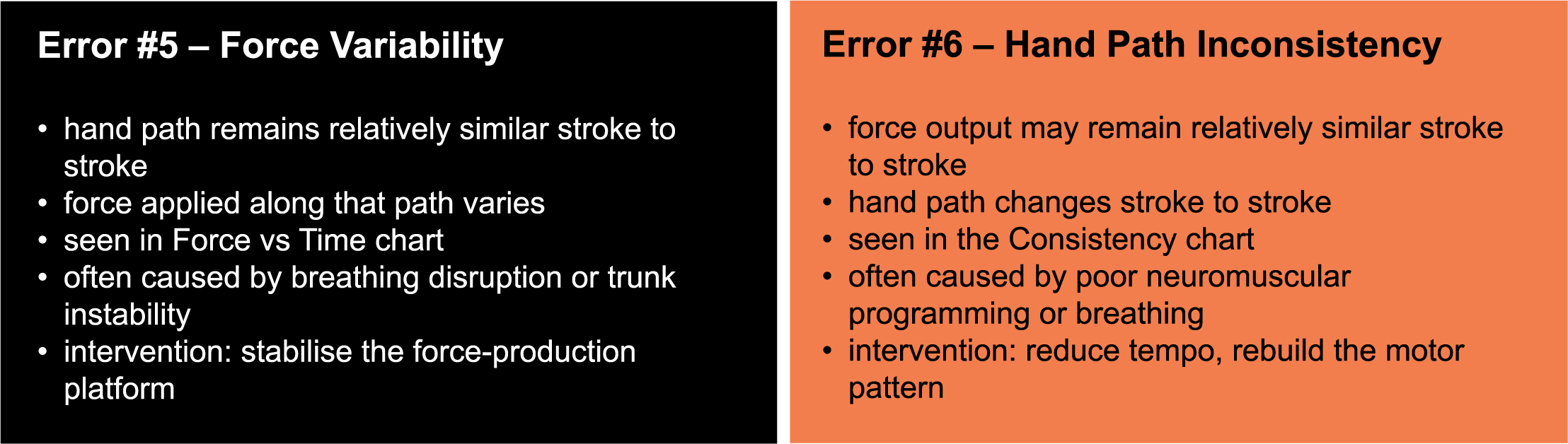
Error #5 (Stroke-to-Stroke Force Variability) and Error #6 are closely related but measure different things. Error #5 is about the force output varying from stroke to stroke. Error #6 is about the physical path of the hand varying from stroke to stroke.
A swimmer can show high force variability without poor hand path consistency – if the hand always travels the same route but the force applied along that route fluctuates. Equally, a swimmer can show inconsistent hand paths while maintaining relatively stable average force – if they are compensating for the variable path with variable effort.
In practice, the two errors often appear together. But they don't always – and distinguishing between them is important because the interventions are different.

Why does it happen?
Poor Neuromuscular Repeatability
The most fundamental cause. Swimming is a motor skill – and like all motor skills, it requires thousands of repetitions of the correct movement pattern before that pattern becomes deeply ingrained and reliably repeatable under pressure.
Many swimmers have not yet accumulated the volume of correct repetitions needed for the stroke to become truly automatic. They know what the correct movement feels like. They can produce it when concentrating. But without deep neuromuscular programming, the movement drifts whenever attention shifts – during a race, under fatigue, while processing a coach's instruction, or simply across the course of a long set.
This is not a fitness problem. It is a motor learning problem. And it has a specific solution: more repetitions of the correct pattern, at a pace slow enough to ensure those repetitions are actually correct.
Technical instability
A stroke that has been built on an unstable foundation – poor trunk control, inconsistent rotation, variable breathing mechanics – will produce inconsistent hand paths as a downstream consequence. The hand goes where the body sends it. If the body is in a slightly different position on every stroke, the hand will take a slightly different path.
This is why Error #6 often appears alongside Error #5. The same instabilities that cause force to vary from stroke to stroke also cause the hand path to vary. In these cases, fixing the foundation – breathing mechanics, trunk stability – improves both errors simultaneously.
Breathing disruption
As with Error #5, breathing is one of the most common contributors to hand path inconsistency. When a swimmer over-rotates or lifts their head to breathe, the arm on the breathing side follows the body's movement – diving deeper, pulling wider, or shortening its path. The Consistency chart will often show a clear two-cluster pattern: tight consistency on non-breathing strokes, noticeably wider scatter on breathing strokes.
The snorkel test is again the fastest diagnostic here. If the scatter on the Consistency chart reduces significantly with a snorkel, breathing is the dominant cause and the intervention starts there.
Inconsistent hand paths are the footprint of an unstable stroke. The chart shows where the hand went. The question is always: why did it go somewhere different each time?
Why it matters
Even a good stroke loses efficiency if it isn't repeatable
This is the central insight of Error #6 – and it is worth sitting with for a moment. A swimmer can have excellent catch mechanics, good force direction, solid propulsive percentage – all the markers of quality technique. And yet if those mechanics vary significantly from stroke to stroke, the efficiency advantage of good technique is only partially realised.
On the strokes where the hand follows the optimal path, the technique is working. On the strokes where it drifts – deeper, shallower, wider, narrower – the efficiency drops. The average across all strokes is what determines speed. And an average that includes frequent deviations from the optimal path is a lower average than a consistent stroke would produce.
Training reinforces whatever pattern is being repeated
This is where inconsistency becomes genuinely dangerous in a training context. Every repetition of a movement – whether correct or incorrect – reinforces the neural pathway for that movement. A swimmer who completes 5,000 metres of training with a variable hand path is reinforcing variability. They are not just failing to improve – they may be making inconsistency harder to correct, because the nervous system is learning that variability is the expected pattern.
Quality of repetition matters as much as volume. Arguably more.
Inconsistency under pressure
Hand path consistency that is acceptable at easy training pace often breaks down at race pace or under fatigue. A swimmer whose Consistency chart looks reasonable during warm-up may show dramatically wider scatter in race-pace sets. This is the motor programme being stress-tested – and revealing that it hasn't been embedded deeply enough to withstand the additional cognitive and physical demands of high-intensity swimming.
The connection to distance per stroke
Recalling the paddle concept: every deviation from the optimal hand path is a deviation from the most efficient anchor point. A hand that travels too deep anchors in the wrong place. A hand that pulls too wide loses propulsive direction. Each of these deviations reduces the distance the body travels per stroke – and a swimmer with inconsistent hand paths will show a more variable DPS than one whose paths are tightly clustered.
The snorkel test – again
Just as with Error #5, the snorkel is the first diagnostic tool to reach for with hand path inconsistency. The test protocol is the same: compare Consistency chart data with and without a snorkel.
Reading the snorkel result on the Consistency chart:
If scatter reduces significantly with the snorkel:
- breathing mechanics are disrupting the hand path
- intervention starts with rotation control and head position during breathing
If scatter remains similarly wide with the snorkel:
- the issue is deeper neuromuscular programming or structural instability
- intervention focuses on motor pattern repetition and building trunk stability
What to do about it
Step 1: Identify the pattern of inconsistency
Before intervening, read the Consistency chart carefully. Is the scatter concentrated on one view – side on, overhead, or head on? Is it present on both hands or predominantly one? Does it track with breathing strokes? The pattern tells you where the motor programme is breaking down and helps target the correction precisely.
Step 2: Run the snorkel test
Compare Consistency chart data with and without a snorkel. If the scatter reduces, breathing is the primary contributor. If it remains, the issue is neuromuscular or structural. The snorkel result immediately narrows the intervention focus.
Step 3: Slow it right down
Motor patterns are rebuilt through slow, deliberate, correct repetition. Reduce stroke rate significantly – to a pace where the swimmer can consciously control the hand path and feel when it deviates from the correct route. This is not the time for race-pace work. Speed without correctness is counterproductive when rebuilding consistency.
Drills are valuable here – not because they are inherently corrective, but because they slow the movement down and give the swimmer time to feel the correct path. Single-arm swimming, catch-up drill, and fingertip-drag entry all force slower, more deliberate hand positioning and allow the swimmer to build the correct movement pattern with conscious attention.
Step 4: Build repetition volume at correct tempo
Once the swimmer can reliably produce the correct hand path at reduced tempo, the goal becomes accumulating repetitions of that correct pattern. Volume matters here – but only correct-pattern volume. A useful training approach is to alternate focused technique sets (low tempo, high attention) with slightly faster sets while monitoring whether the improvement transfers. If it doesn't transfer at slightly higher tempo, return to the slower work and build more repetitions before attempting to increase pace again.
Step 5: Gradually rebuild tempo
Once consistency improves at low tempo – confirmed by tighter clustering on the Consistency chart – stroke rate can be gradually increased. At each tempo increment, review the chart. Is the clustering holding? Is the scatter staying narrow as speed increases? The goal is for the improved pattern to remain stable all the way to race pace.
This process takes time. Deep motor reprogramming requires patience and sustained correct practice. But the data makes the progress visible at every step – the progressively tighter clustering on the Consistency chart makes the process both measurable and motivating.
Step 6: Address breathing mechanics in parallel if required
If the snorkel test confirmed that breathing is a significant contributor, breathing mechanics should be worked on as a parallel priority. Breathing correction alone will not fix neuromuscular inconsistency – but leaving breathing as an unaddressed variable means the improved motor pattern will continue to be disrupted on every breathing stroke, limiting the gains from all other work.
The bigger picture
Error #6 represents a different kind of technique problem to the errors that precede it. Errors #1 through #5 are largely about what the hand is doing – the direction of force, the timing of the catch, the consistency of the force output. Error #6 is about whether the hand can reliably do the right thing at all.
It is a motor learning problem as much as a technique problem. And it is one of the most important to address – because no amount of technique coaching will produce lasting speed improvement if the improved movement cannot be reproduced consistently under race conditions.
Technique is what you can do. Repeatability is what you actually do. Speed is built on the second one.
The eo SwimBETTER Consistency chart makes the gap between the two visible in a way that nothing else can. It doesn't show one stroke. It shows all of them – overlaid, compared, and ready to tell the story of how well the motor programme is actually working.
That story – and the coaching it enables – is exactly why measuring movement is more powerful than observing it.
Slow it down.
Build the correct pattern.
Accumulate the repetitions.
Then let the data confirm the programme has embedded.
How repeatable is your stroke – stroke after stroke?
Hand Position Inconsistency is just one of 12 measurable freestyle errors identified through eo SwimBETTER data.
Download the full Technical Error Index to learn:
- the hidden technique patterns slowing swimmers down
- why they happen
- how to identify them in the data
- and what the evidence says about fixing them
Related topics: stroke repeatability swimming; hand path consistency freestyle; motor learning swimming; swim technique consistency; neuromuscular swimming; eo SwimBETTER; Consistency chart swimming; swimming biomechanics; freestyle technique drills; breathing technique swimming; swim coaching data; distance per stroke; swimming efficiency; inconsistent hand path swimming; freestyle hand path inconsistency; swimming motor learning; why does my stroke change every lap; swimming stroke repeatability; hand path variability swimming
Back