
Understanding Stroke-to-Stroke Force Variability
By Jaimie Fuller
Think about the best swimmer you've ever watched.
What made them look different?
It probably wasn't one extraordinary stroke. It was the fact that every stroke looked the same. Lap after lap. Breath after breath. Into the turn and out the other side. The same rhythm, the same reach, the same drive – stroke after stroke, almost without variation.
That repeatability is not an accident. It is a skill – and one that is as trainable, and as measurable, as any other aspect of technique.
When it breaks down, eo SwimBETTER captures it in the Force vs Time chart as erratic, inconsistent propulsive peaks – a stroke cycle that changes every time it repeats. This is Stroke-to-Stroke Force Variability, Error #5 in the Technical Error Index, and one of the most telling signals that something fundamental in a swimmer's mechanics needs attention.
What is Stroke-to-Stroke Force Variability?
Every freestyle stroke should produce a recognisable, repeatable force signature. In the Force vs Time chart, a consistent swimmer shows a clean, rhythmic waveform – propulsive force peaks rising and falling in a regular pattern, left and right alternating predictably, lap after lap.
Stroke-to-Stroke Force Variability is what the data looks like when that pattern breaks down. Instead of a clean waveform, you see erratic peaks – some strokes generating strong propulsive force, others barely registering. The pattern becomes unpredictable. Peak heights differ. Timing shifts. The curve looks jagged and inconsistent rather than smooth and repeatable.
The swimmer may be working just as hard on every stroke. But the force output – and therefore the speed contribution – of each stroke is different. And in swimming, inconsistency is inefficiency.
In eo SwimBETTER, Stroke-to-Stroke Force Variability appears as:
- erratic Force vs Time curves – peaks and valleys vary significantly stroke to stroke
- inconsistent propulsive peaks – some strokes driving strongly, others falling well short
- high propulsive variability within a single lap, not just between laps
- a stroke pattern that changes almost every cycle
Why does it happen?
Stroke-to-Stroke Force Variability is rarely caused by a single isolated fault. It is almost always a symptom of instability somewhere in the stroke's foundation – a platform that isn't stable enough to support consistent force production stroke after stroke.
Three causes account for the vast majority of cases we see in eo SwimBETTER data.
1. Over-rotation during breathing
This is the most common cause – and the most frequently overlooked. When a swimmer over-rotates to breathe, the entire body position shifts dramatically on every breathing stroke. The shoulder drops too far, the hips follow, the catch arm loses its anchor, and the stroke cycle is fundamentally disrupted every time a breath is taken.
The result in the data is unmistakable: propulsive force drops sharply on breathing strokes and recovers on non-breathing strokes, creating a repeating variability pattern that tracks directly with the breathing cycle. In a swimmer breathing every two strokes, this means half of all strokes are compromised.
Over-rotation during breathing is particularly damaging because it is self-reinforcing. The harder the swimmer works, the more they need to breathe, the more they rotate, and the more variable their stroke becomes – precisely when consistency matters most.
2. Trunk instability
The trunk is the platform from which all stroke force is generated. When trunk stability is poor – whether due to weak core engagement, excessive lateral movement, or poor rotation control – the arms have no reliable base to pull against. Each stroke is launched from a slightly different position, arrives at a slightly different catch point, and produces a slightly different force output.
Trunk instability often goes unnoticed because it doesn't produce a single dramatic fault – it just introduces noise into every aspect of the stroke. The swimmer may have decent technique in isolation, but without a stable platform they cannot reproduce it consistently.
3. Fatigue breakdown
As a swim progresses and fatigue accumulates, the motor patterns that produce consistent stroke mechanics begin to degrade. The swimmer starts to compensate — shortening the stroke on one side, dropping the elbow earlier, losing core engagement. Each compensation introduces variability, and the Force vs Time curve becomes progressively more erratic as the swim continues.
Fatigue-related variability is worth distinguishing from structural variability. If the Force vs Time chart is relatively consistent in early laps and deteriorates progressively, the swimmer has the right movement patterns – they just lack the endurance to maintain them. If variability is high from the very first lap, the issue is structural rather than conditional.
Variability is not random. It has a cause – and the data almost always points directly to it.
A critical coaching note – when to shift your approach
There is an important distinction in how eo SwimBETTER data should be read when variability is extreme – and this is one of the most valuable coaching insights the Technical Error Index contains.
When stroke-to-stroke variability is mild to moderate, individual stroke analysis in the Force vs Time chart is informative and actionable. You can identify which strokes are producing good force, which are falling short, and what the pattern suggests about the underlying cause.
But when variability is extreme – when the waveform is so erratic that almost no two strokes look alike – individual stroke analysis becomes unreliable. The noise overwhelms the signal. Trying to draw specific technical conclusions from an extremely variable Force vs Time chart is like trying to read a map in a storm.
When variability is extreme – shift to macro analysis:
Move focus away from the Force vs Time chart and onto three charts that reveal the bigger picture:
Stroke Rate & Force – overall output and bilateral balance
Force Field – where the force is going on average
Consistency – hand path repeatability
These provide the macro view of what's happening – and a clearer starting point for intervention – without getting lost in the noise of an erratic waveform.
This is a genuinely important coaching principle. The instinct when faced with highly variable data is to look harder at the individual strokes. But with extreme variability, the right move is to step back, look at the averages and trends, and identify the dominant structural issue first. Fix that, and the variability will reduce – at which point the Force vs Time chart becomes readable and useful again.
Why it matters
Speed requires repeatability
Swimming speed is built on the ability to apply consistent propulsive force stroke after stroke. Each stroke contributes a unit of momentum to the swimmer's forward movement. When some strokes contribute significantly less than others – or almost nothing – those strokes are effectively wasted. The swimmer covers less distance per stroke cycle and must work harder to maintain pace.
The best swimmers in the world are not necessarily those who produce the highest peak force on their best stroke. They are those who produce excellent force on every stroke – consistently, from the first length to the last.
Variability compounds under pressure
The conditions that cause variability – breathing disruption, trunk instability, fatigue – all get worse as a race or training set intensifies. A swimmer with moderate variability in warm-up may show extreme variability in the final 200m of a 1500. The pattern that was manageable at low intensity becomes race-defining at high intensity.
This is why training at race pace matters – not just to build fitness, but to expose variability that only appears under real pressure. The eo SwimBETTER data at race pace often tells a very different story to the same swimmer at training pace.
Micro timing refinements are wasted on a variable stroke
There is a coaching hierarchy here that matters enormously in practice. When stroke-to-stroke variability is high, fine-tuning micro timing – the precise angle of hand entry, the exact moment of catch initiation, the degree of rotation – produces almost no benefit. The stroke changes so much from one cycle to the next that micro refinements are overwhelmed by the underlying instability.
Stabilise the stroke first. Then refine it. Attempting to do both simultaneously is one of the most common reasons that technique coaching fails to produce lasting improvement.
The snorkel test – a diagnostic tool
The snorkel is one of the most useful diagnostic tools available for this error – and it costs a fraction of what any piece of technology does. The test is simple:
Have the swimmer complete a set with a snorkel, and compare the Force vs Time data to a set without one. The snorkel eliminates the breathing rotation entirely – the head stays still, excessive breathing rotation is removed, and the stroke is freed from one of its most common sources of disruption.
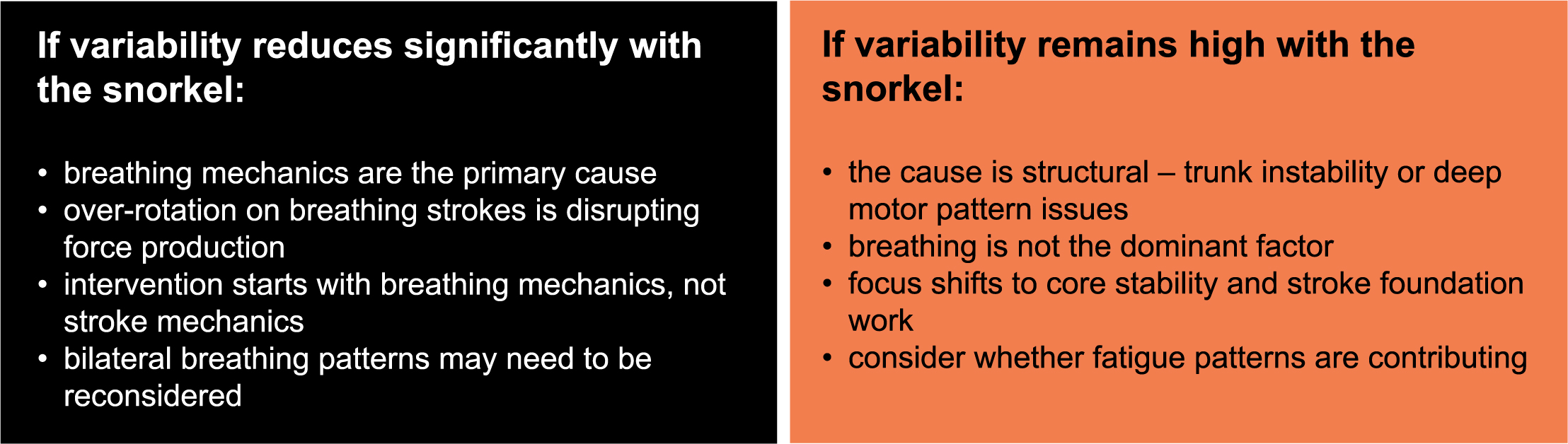
The snorkel test is a branching diagnostic – it immediately narrows the field of possible causes and points the coaching intervention in the right direction. Without it, you may spend weeks working on breathing mechanics when the issue is trunk instability, or vice versa.
What to do about it
Step 1: Run the snorkel test
Always start here. Compare Force vs Time data with and without snorkel. The result tells you which direction to take the intervention and prevents wasted effort on the wrong cause.
Step 2: If breathing-related – fix the breathing
Work on head and shoulder rotation during the breath. The head should rotate with the body – not lift independently. The shoulder should not drop excessively on the breathing side. The non-breathing arm should maintain its catch position and not collapse as the body rotates. Reduce stroke rate temporarily to give the swimmer time to feel the correct rotation, and confirm improvement with post-intervention Force vs Time data.
Step 3: If structural – stabilise the trunk
Core engagement through the stroke cycle is the foundation. The swimmer should maintain a stable, controlled rotation – not a reactive, collapsing one. Drills that emphasise trunk control – side-kick, catch-up with deliberate rotation pause, single-arm with body position focus – rebuild the stable platform that consistent force production requires.
Step 4: Reduce stroke rate and rebuild consistency
Regardless of cause, the intervention should begin at a reduced stroke rate. Motor patterns are rebuilt more effectively when the swimmer has time to feel the correct movement and consciously reinforce it. Once consistency improves at lower tempo – confirmed by a smoother, more regular Force vs Time waveform – stroke rate can be gradually increased.
The key metric to track during this process is not speed or stroke rate — it is the regularity of the Force vs Time waveform. Is the variability between peaks reducing? Are the strokes starting to look more like each other? That is the signal that the intervention is working.
Step 5: Stress-test at race pace
Once consistency improves at training pace, test it under pressure. Have the swimmer complete race-pace efforts and review the Force vs Time data. Variability that disappears at easy pace but returns at race pace indicates that the movement pattern is improving but not yet fully automated. This is normal – and it tells the coach exactly what the next training priority should be.
The bigger picture
Stroke-to-Stroke Force Variability is listed fifth in our Technical Error Index for a reason. It sits downstream of the force direction errors – Errors #1 through #4 – because it often appears as a consequence of those deeper faults. A swimmer with a poor catch, asymmetric force production, or breathing-related disruption will almost always show elevated variability.
But it also stands alone as an error in its own right – because variability can exist even in swimmers whose average technique is reasonable. A swimmer can have a good catch, solid propulsive percentage, and acceptable force direction, and still be producing wildly inconsistent results from one stroke to the next. Technique quality and technique repeatability are not the same thing.
A great stroke performed inconsistently is not a great stroke. It is a great stroke and several lesser ones – and the average is what determines speed.
Elite swimming is built on repeatability. The goal is not to produce one perfect stroke. It is to produce the same good stroke – reliably, rhythmically, under pressure – from the first length to the last.
eo SwimBETTER makes the variability visible, identifies its cause, and tracks the improvement as it's corrected. Because you cannot stabilise what you cannot measure.
Find the cause of the variability.
Fix the foundation.
Build the repeatability.
Then refine the stroke on top of it.
How consistent is your stroke – really?
Stroke-to-Stroke Force Variability is just one of 12 measurable freestyle errors identified through eo SwimBETTER data.
Download the full Technical Error Index to learn:
- the hidden technique patterns slowing swimmers down
- why they happen
- how to identify them in the data
- and what the evidence says about fixing them
Related topics:
stroke consistency swimming; freestyle power variability; freestyle force variability; swim technique repeatability; breathing technique freestyle; trunk stability swimming; eo SwimBETTER; swimming force measurement; stroke rate swimming; swim coaching data; fatigue swimming technique; distance per stroke; swimming biomechanics; Force vs Time swimming; inconsistent freestyle stroke; why does my stroke feel different every lap; swimming stroke inconsistency; swimming breathing instability; race pace technique breakdown; swimming repeatability
Back