
Understanding Excessive Downward Force + Hand Drag
By Jaimie Fuller
Error #3 showed us what happens when the hand pushes down instead of driving backward.
Error #4 shows us what happens when the problem starts even earlier.
Excessive Downward Force combined with Hand Drag is not simply a more severe version of Error #3. It is a distinct sequencing fault – one where the breakdown begins during the glide phase, before the catch even starts, and cascades through the entire stroke cycle as a result.
Two separate problems are happening simultaneously and each makes the other worse. Together, they represent one of the most mechanically damaging patterns we see in eo SwimBETTER data.
The critical distinction, and the reason this error earns its own entry in the Technical Error Index, is this:
This is a sequencing fault. Not simply a weak catch. The stroke is already failing before propulsion has a chance to begin.
What is error #4 – and how is it different from error #3?
Error #3 (Excessive Downward Force) describes a catch that presses down rather than drives back. It is a force-direction problem – the hand is in roughly the right place, but oriented and applied incorrectly.
Error #4 adds a second, upstream failure: hand drag during the glide phase. This means that before the hand attempts a catch, it is already moving in the wrong direction – scooping upward through the water during the extension, generating drag and disrupting the body's forward momentum.
The result is a stroke that is compromised in two places at once: during the glide, and again at the catch. Forward momentum is interrupted. Energy is wasted twice. And the timing of the entire stroke cycle deteriorates.
In eo SwimBETTER, this error appears across two charts:
- Force Field chart: elevated downward force %, hand drag above 0%, reduced propulsive contribution
- Force vs Time chart: visible hand drag force spikes during each stroke cycle, confirming the glide-phase disruption
- Together, these signals form the definitive marker of Error #4
The sequence: how the fault unfolds
Understanding Error #4 requires understanding it as a chain of events rather than a single flaw. Each step in the sequence causes the next – which is why treating only one part of the problem rarely delivers lasting improvement.
The typical fault sequence in Error #4:
- The elbow drops early – before the glide phase is complete
- As the elbow drops, the fingers pop upward to compensate, creating hand drag
- The hand then presses downward excessively as the swimmer attempts to initiate the catch from a compromised position
- The catch is delayed – the hand is already past the optimal catch point before meaningful propulsion begins
- Propulsion is reduced – the stroke produces less forward drive than it should, for more effort than it should require
This is why the Force vs Time chart is so revealing for this error. Each stroke cycle shows a characteristic spike pattern – hand drag during the glide, followed immediately by elevated downward force during the catch attempt. The data signature is unmistakable once you know what to look for.
The hand drag spike in the Force vs Time chart is the data telling you: the elbow has already dropped, and the stroke is already in trouble.
Targets: what the data should show
eo SwimBETTER provides specific benchmarks for both components of this error. Both targets need to improve together. Fixing one without the other usually means the sequence has only been partially corrected.
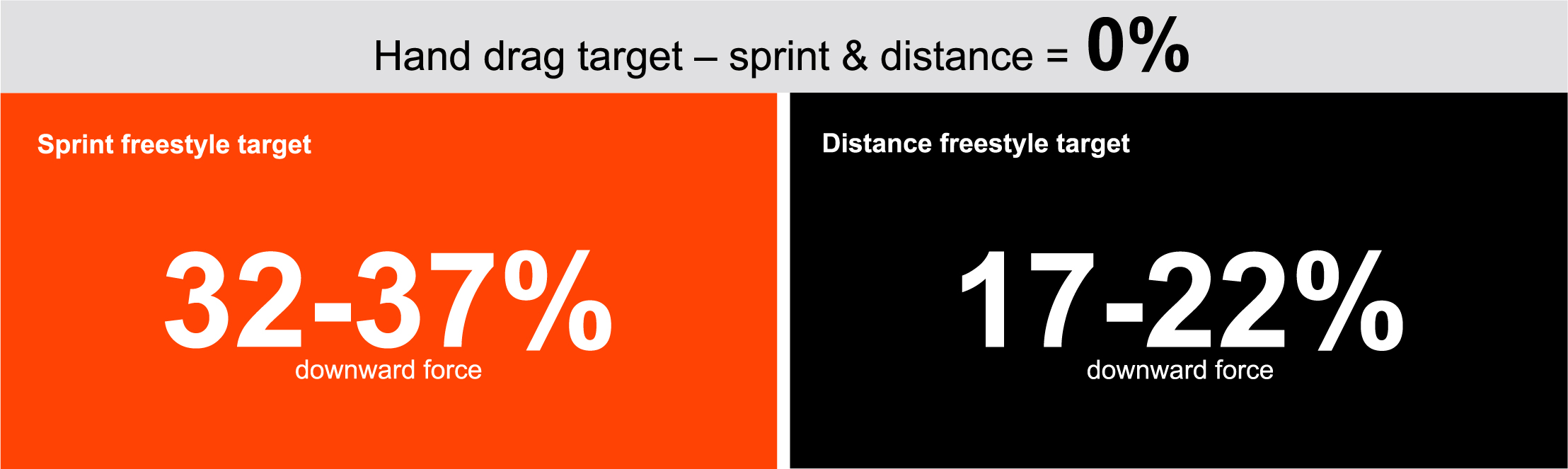

Hand drag should be zero. Any positive value in the hand drag measurement means the glide phase is already generating resistance and wasting energy before the catch begins. Even small amounts – 2-3% – are worth addressing because they signal the elbow-drop sequence has begun.
Downward force targets are identical to Error #3, because the underlying mechanical problem at the catch phase is the same. The difference is what precedes it – and how that upstream fault makes the catch problem harder to correct in isolation.
Why it matters – double the waste
Energy lost twice per stroke
In a stroke with hand drag and excessive downward force, the swimmer loses efficiency at two distinct points in every single stroke cycle. Energy is wasted during the glide phase generating drag. More energy is wasted during the catch phase generating downward rather than propulsive force. These losses are additive. Every stroke costs more than it should, and produces less than it should.
Forward momentum is actively interrupted
Hand drag during the glide phase doesn't just fail to contribute to propulsion – it actively creates resistance. The hand scooping upward catches water in the wrong direction, creating a braking effect at the precise moment the swimmer should be carrying momentum from the previous stroke. The stroke cycle is disrupted at its foundation.
The catch is delayed and compromised
Because the elbow has already dropped before the catch begins, the swimmer arrives at the catch phase in a mechanically poor position. The high elbow needed for an efficient early vertical forearm is gone. The hand is already below the optimal catch point. The swimmer is effectively trying to build propulsion from a deficit – and the data reflects this with lower propulsive percentages and elevated downward force combined.
Timing deteriorates across the stroke cycle
A stroke cycle that loses momentum during the glide and then generates a delayed, inefficient catch creates timing problems that ripple through the rest of the stroke. Kick timing changes. Rotation becomes inconsistent. Breathing mechanics are disrupted. What looks like multiple separate issues is often a single upstream fault – the early elbow drop – expressing itself at every stage of the cycle.
The problem compounds under fatigue
At low stroke rates or during easy swimming, a swimmer may partially compensate for this fault. As pace increases and fatigue builds, the compensation mechanisms break down. The elbow drops earlier, the hand drag increases, and the catch deteriorates further. Error #4 is one of the errors that becomes most visible – and most damaging – at race pace and in the later stages of longer events.
The key distinction – sequencing, not strength
This is the most important coaching insight for Error #4, and the reason it is treated as a separate entry from Error #3 in the Technical Error Index.
When a coach sees hand drag and excessive downward force in the data, the instinct may be to focus on the catch – to work on hand pitch, forearm orientation, and the pull phase. These are valid interventions for Error #3. But for Error #4, they address the consequence rather than the cause.
Fix the glide first. The catch cannot be corrected while the upstream fault remains.
The elbow drop during the glide phase is the root of this error. Until the hand maintains a correct downward trajectory during extension – rather than scooping upward – the catch will always begin from a compromised position, regardless of how much work is done on pitch and forearm mechanics.
This is also why eo SwimBETTER's Force vs Time chart is so valuable here specifically. It doesn't just show that downward force is elevated – it shows exactly when in the stroke cycle the fault occurs. The hand drag spike preceding the downward force peak is the data fingerprint of Error #4, and it tells the coach exactly where to intervene.
What to do about it
Because Error #4 is a sequencing problem, the intervention must follow the sequence. Correct upstream first. Confirm improvement with data. Then address downstream effects.
Step 1: Confirm the sequence in the data
Use both the Force Field and Force vs Time charts together. Look for the hand drag spike in the Force vs Time chart – does it consistently precede the downward force peak? If yes, you are looking at a genuine sequencing fault. The glide phase is the starting point for correction, not the catch.
Step 2: Address the glide trajectory
The hand should travel on a gentle downward trajectory during the glide phase – not scoop upward. A useful coaching focus is to ensure the fingertips are leading downward as the arm extends, keeping the wrist above the fingers throughout the glide. The moment the fingers pop upward and the wrist drops below them, hand drag is being generated.
Drills that slow the glide phase down – front-quadrant swimming, catch-up drill, single-arm with deliberate glide – allow the swimmer to feel the difference between a downward glide trajectory and an upward scoop.
Step 3: Maintain elbow position through the glide
The elbow drop that triggers the fault sequence often begins during the glide as the swimmer relaxes through extension – the shoulder drops, and the elbow falls below the wrist. Coaching focus on keeping the elbow above the wrist throughout the glide phase directly addresses the trigger. The 'over the barrel' cue from Error #3 applies here too – but the emphasis moves to the glide phase rather than the catch initiation.
Step 4: Once the glide is corrected, address the catch
With a correct glide trajectory established, the catch phase will naturally improve – because the hand and forearm are now arriving at the catch point in a better mechanical position. At this stage, the Error #3 interventions apply: hand pitch, early vertical forearm, and the backward drive of the pull phase.
Step 5: Use a snorkel to isolate breathing contribution
If the hand drag spikes are most prominent on breathing strokes, breathing mechanics are compounding the fault. Head lift during breathing disrupts shoulder position and accelerates the elbow drop. Snorkel testing will reveal this pattern – and if confirmed, breathing mechanics become an additional parallel priority.
Step 6: Confirm with post-intervention data
The Force vs Time chart is the primary confirmation tool. After intervention, the hand drag spikes should reduce or disappear. The Force Field chart should show downward force moving toward target range simultaneously. If hand drag reduces but downward force remains elevated, the glide is improving but the catch still needs work – a clear, sequential picture that guides the next coaching focus.
The bigger picture
Error #4 represents something important about what data-driven coaching makes possible. The hand drag that triggers this fault sequence is invisible to pool deck observation. Video may catch an elbow drop – but it cannot quantify the momentum lost and energy wasted on every stroke.
eo SwimBETTER makes the sequence visible, measurable, and correctable. The Force vs Time chart doesn't just identify the problem – it timestamps it within the stroke cycle, showing exactly where the fault begins and how it cascades.
Two problems. One upstream cause. Data that shows both – and where to start fixing them.
For swimmers and coaches who have been working on catch mechanics without achieving consistent improvement, Error #4 is often the reason why. The catch keeps failing not because the catch itself hasn't been coached – but because the elbow is dropping in the glide phase before the catch even begins.
Fix the glide trajectory.
The catch will follow.
The data will confirm both.
Is your stroke breaking before it begins?
Error #4 is just one of 12 measurable freestyle errors identified through eo SwimBETTER data.
Download the full Technical Error Index to learn:
- the hidden technique patterns slowing swimmers down
- why they happen
- how to identify them in the data
- and what the evidence says about fixing them
Related topics: hand drag swimming; freestyle catch fault; elbow drop swimming; glide phase freestyle; swimming sequencing fault; catch mechanics freestyle; eo SwimBETTER; swimming force measurement; freestyle propulsion loss; swim technique analysis; early vertical forearm; swimming biomechanics; freestyle hand drag; swimming elbow drop; glide phase swimming problems; why does my catch collapse; swimming catch timing; freestyle sequencing issue
Back