
Understanding Excessive Downward Force
By Jaimie Fuller
You reach forward, you feel the water, and you pull.
Or at least – that's what it feels like.
For a significant number of freestyle swimmers, what feels like a strong pull through the water is, in reality, something quite different. The hand enters, the arm extends – and instead of anchoring on the water and driving backward, the hand presses down.
Downward. Not backward. Not into propulsion.
This is Excessive Downward Force – Error #3 in the eo SwimBETTER Technical Error Index, and one of the most wasteful technique problems we see in freestyle data. It's common across all levels, particularly pronounced in distance swimmers, and almost impossible to identify from pool deck observation alone.
The swimmer feels like they're working. The data shows that much of that work is going in the wrong direction entirely.
What is Excessive Downward Force?
Every freestyle stroke generates force in multiple directions simultaneously. Some of that force drives the swimmer forward – this is the propulsive component. Some is directed downward, in an attempt to support body position. And some is lost to lateral or upward vectors that contribute nothing useful.
A healthy stroke keeps downward force within a specific target range – enough to support body position, not so much that it robs propulsion. When downward force climbs above that range, it signals that the swimmer's energy is being misdirected at one of the most critical phases of the stroke: the catch.
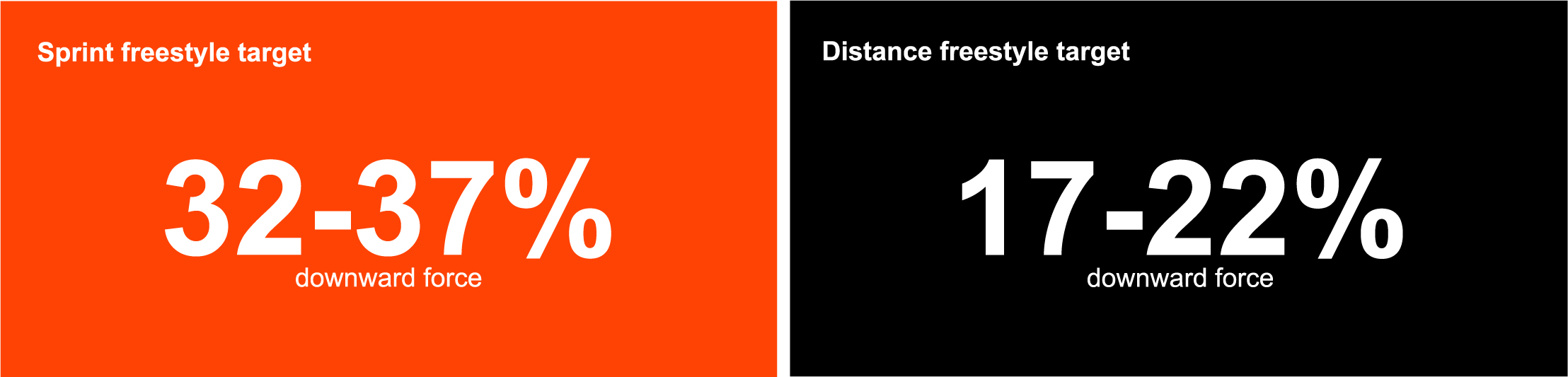

These are the eo SwimBETTER benchmarks for healthy downward force contribution. Sprint swimmers naturally generate more downward force because straighter-arm sprint mechanics create different force angles than the high-elbow catch used by distance swimmers. Distance swimmers should direct far more of their effort rearward than downward to maximise efficiency over hundreds of strokes.
There is ongoing debate in swimming circles about whether downward force meaningfully lifts the body higher in the water and improves hydrodynamics. The evidence does not support this.
Some downward force is unavoidable during the transition from extension into catch. But beyond that brief transitional role, excessive downward force is largely wasted effort.
The goal is not to eliminate downward force entirely, but to keep it within the target range.
When values climb well above these ranges, the data shows something clear: the hand is pressing down through the water, not pushing back through it.
In eo SwimBETTER, excessive downward force appears in the Force Field chart as:
- an elevated downward force percentage – often well above the target range
- a reduced propulsive contribution on the same hand
- sometimes accompanied by hand drag in the glide phase (see Error #4)
Why does it happen?
Excessive Downward Force is almost always a catch problem. Something goes wrong in the brief but critical moment when the hand transitions from extension to the beginning of the pull – and instead of anchoring high and sweeping backward, it drops and presses down.
There are several distinct causes, and identifying the right one is essential before any intervention is made.
Poor hand pitch at catch
The most direct cause. At the moment of catch, the hand should be angled so the palm faces backward – or at least at an angle that allows force to be directed rearward. When the wrist drops and the fingers point down rather than back, the hand becomes a downward paddle instead of a propulsive surface. Every ounce of effort applied in that position is pushing the swimmer up, not forward.
Early vertical forearm not achieved
The early vertical forearm (EVF) position – where the elbow stays high and the forearm drops vertically – is the foundation of an efficient catch in freestyle. It creates maximum propulsive surface area and directs force backward from the very beginning of the pull. When EVF isn't achieved, the elbow typically drops first, the forearm follows, and the hand ends up pressing downward rather than engaging a backward pull.
This is particularly common in distance swimmers. At lower stroke rates, there's a tendency to over-glide and then scramble to initiate the pull – often with poor positioning that leads directly to a downward press rather than a backward drive.
Overemphasis on 'feeling' the water
Many swimmers are coached to press down during the catch to 'feel' the water and establish grip. In moderation, some downward pressure at catch initiation is normal and expected. But when swimmers overdo this – pressing hard downward to generate that sensation of grip – they misdirect significant force away from propulsion. What feels like a strong, connected catch is actually an expensive energy leak.
Breathing technique
Poor breathing mechanics can contribute to downward force patterns, particularly on the breathing side. When a swimmer lifts the head to breathe – rather than rotating – the compensatory drop in shoulder and arm position often causes the catching hand to press downward as the body scrambles to maintain balance. This creates a pattern where downward force spikes on every breathing stroke.
What feels like a strong catch is sometimes just an expensive push in the wrong direction.
The 'dropped elbow' nuance
Excessive Downward Force is often associated with a dropped elbow – and frequently, that association is correct. When the elbow falls below the wrist at the catch, the mechanical outcome is almost always a downward press rather than a backward drive.
But the relationship isn't absolute. A swimmer can exhibit elevated downward force without a classically dropped elbow – particularly when the issue is hand pitch (wrist angle) rather than elbow position. This is why eo SwimBETTER data is so valuable here: it measures the outcome (force direction) rather than making assumptions about the cause.
The data shows what the hand is actually doing – not what it looks like it's doing from the pool deck.
A coach observing from poolside may see a stroke that looks technically reasonable. The eo SwimBETTER Force Field may simultaneously show 45%, 50%, or more of total force going downward rather than backward. Those are not the same swimmer – even if they look like one.
Why it matters – the real cost of pushing down
Wasted energy on every single stroke
Downward force beyond the target range represents effort that produces no forward speed. In a 1500m freestyle event, a swimmer might take 900 to 1,100 strokes. If each stroke is misdirecting 15-20% more force downward than it should, the cumulative energy waste across a race is enormous – effort expended, metabolic cost incurred, and no speed gain to show for it.
Propulsion is robbed at the most critical phase
The catch is where propulsion begins. It's the moment the hand engages the water and begins to drive the body forward. When that phase is dominated by downward force, the most important part of the stroke cycle is effectively neutralised. The swimmer never builds the propulsive momentum that should carry through the rest of the pull.
Compounding effect at higher stroke rates
At lower stroke rates, a swimmer may partially compensate for a poor catch by generating more force later in the pull. As stroke rate increases – in a sprint, at the end of a distance race, or under fatigue – there's less time to compensate. The downward force problem becomes proportionally more damaging at the moments when technique matters most.
Distance swimmers are disproportionately affected
The distance target of 17-22% downward force is significantly lower than the sprint range for a reason. Distance swimming demands sustained propulsive efficiency over hundreds of strokes. A distance swimmer consistently operating at 35-40% downward force is carrying a technique burden that accumulates with every lap. The longer the race, the more costly it becomes.
What to do about it
Correcting Excessive Downward Force requires working on pitch and forearm orientation before anything else. Increasing stroke rate, adding resistance, or focusing on effort will not help – and may make the problem worse by automating a flawed movement pattern more deeply.
Check the Force Field first
Confirm the scale of the problem and whether one hand is contributing more than the other. Is the issue consistent across laps, or does it spike on breathing strokes? Does it worsen under fatigue? The Force Field chart answers all these questions and informs exactly where the intervention should focus.
Use a snorkel to isolate the cause
If downward force reduces noticeably when swimming with a snorkel, breathing mechanics are a significant contributor. This is a very common finding – and it immediately directs the coaching focus. Improve breathing mechanics first. Then reassess the catch in isolation.
Focus on hand pitch at catch
The hand should enter the water and extend forward with the fingertips angled slightly downward – not the wrist. As the catch begins, the goal is to rotate the palm to face backward (not downward) so that the propulsive surface is oriented for a rearward drive. Even a small adjustment in wrist angle at this moment can produce a measurable shift in the Force Field data.
A useful checkpoint at the end of the glide:
Shoulder above elbow above wrist.
This stacked alignment helps set up the early vertical forearm and position the hand for a propulsive catch rather than a downward press.
Work on 'over the barrel'
A useful coaching cue for this error is the idea of going "over the barrel" – the image of the swimmer's hand and forearm reaching over an imaginary barrel sitting beneath them in the water, rather than pressing down on top of it. This encourages the high elbow position and forward reach that sets up a propulsive catch rather than a downward press.
The barrel cue works because it naturally promotes the early vertical forearm without requiring technical jargon. It gives the swimmer a spatial reference that reorients the entire catch phase.
Slow it right down
Catch mechanics are deeply ingrained movement patterns. Corrections need to be made at very low stroke rates, where the swimmer has time to feel the difference between a downward press and a backward anchor. Drills – finger-drag, catch-up, single-arm with snorkel – are valuable here precisely because they slow the movement down and allow conscious attention to the catch phase.
Measure the change
After intervention, return to the Force Field chart and compare. Is the downward force percentage moving toward the target range? Is propulsive contribution increasing correspondingly? Small measurable improvements in downward force translate directly to speed gains – and the data makes that relationship visible in a way that observation cannot.
The bigger picture
Excessive Downward Force is listed third in our Technical Error Index because it is both extremely common and extremely costly. It appears across all levels of swimmer – from beginners through to competitive athletes – and it is one of the errors most likely to go undetected without objective force measurement.
Pool deck observation shows a stroke. Video shows movement. But neither tells a coach what percentage of every stroke's effort is going in a direction that produces absolutely no forward speed.
The swimmer is working hard. The data shows where that work is actually going.
That's the value of measuring force rather than observing movement. And it's why correcting Excessive Downward Force – once identified and quantified – can produce some of the most immediate and significant speed improvements of any technique intervention in freestyle swimming.
Correct the pitch.
Establish the catch.
Let the data confirm the improvement.
How much of your stroke is going downward?
Excessive Downward Force is just one of 12 measurable freestyle errors identified through eo SwimBETTER data.
Download the full Technical Error Index to learn:
- the hidden technique patterns slowing swimmers down
- why they happen
- how to identify them in the data
- and what the evidence says about fixing them
Related topics: excessive downward force swimming; freestyle catch technique; dropped elbow swimming; early vertical forearm; swim catch mechanics; swimming force measurement; eo SwimBETTER; freestyle propulsion; swim technique analysis; distance swimming efficiency; swimming biomechanics; swimming pushing down not forward; why am I pushing down in freestyle; freestyle catch problems; swimming hand pitch; swimming downward force
Back