
Understanding Propulsive Imbalance
By Jaimie Fuller
Both arms pulling hard.
Similar force on each side.
And yet – the stroke still isn't working the way it should.
This is the hallmark of Propulsive Imbalance – Error #2 in the eo SwimBETTER Technical Error Index, and one of the most misunderstood technique problems we see in freestyle swimming data.
Unlike Total Force Imbalance, where one arm simply produces more raw force than the other, Propulsive Imbalance is more subtle – and in many ways, more instructive. The issue isn't how much force a swimmer generates. It's where that force goes.
And that distinction changes everything about how you fix it.
What is Propulsive Imbalance?
Propulsive Imbalance occurs when both hands generate similar total force – but one converts a significantly higher percentage of that force into forward propulsion.
In eo SwimBETTER, this appears in the Stroke Rate & Force (or Stroke Rate & Force) chart. When you look at the propulsive percentage on each side instead of total output, the picture changes. Two bars of similar height can tell completely different stories about where the force is actually going.
eo SwimBETTER reveals what total force numbers alone cannot:
- the propulsive percentage contribution of each hand
- how much force is directed forward versus downward or sideways
- which hand is converting effort into speed – and which is wasting it
- how propulsive efficiency changes under fatigue or breathing
The Force Field chart takes this further, showing exactly where force is being directed: propulsive, downward, leftward, rightward, and upward. It makes propulsive imbalance immediately visible, even when total force looks balanced.
What it actually means
When one hand has a noticeably lower propulsive percentage than the other, it means that hand is doing work – just not useful work.
The force is going somewhere. But instead of driving the body forward, it's being directed downward, sideways, or at angles that contribute nothing to speed.
The swimmer isn't lacking effort. Their effort is just going in the wrong direction.
Common patterns we see in the data include:
- one hand pushing downward through the catch, rather than engaging a backward pull
- force being directed laterally during the sweep – outward or inward – rather than rearward
- a palm that is misaligned despite an apparently straight pull path
- a hand that loses its 'anchor' on the water mid-stroke, reducing effective surface area
In every case, the energy expenditure looks similar on both sides. But the propulsive return on that effort is not.
The critical distinction – direction, not strength
This is the most important thing to understand about Propulsive Imbalance:
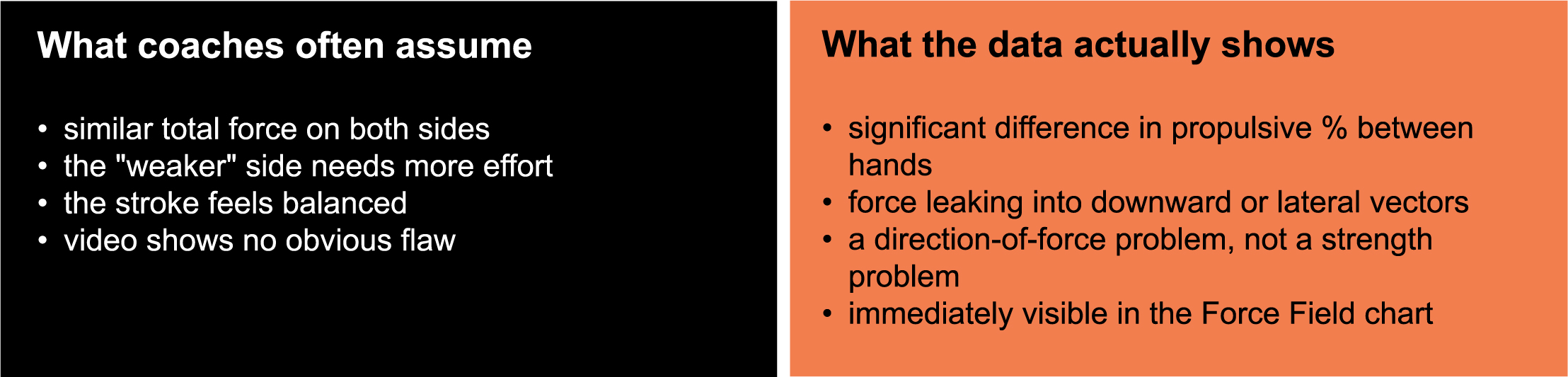
This is a directional efficiency problem – not a strength problem.
That distinction matters enormously in practice. A coach who sees propulsive imbalance and prescribes more pulling on the weaker side is solving the wrong problem. Adding effort to a hand already misdirecting force simply creates more wasted energy – without improving speed.
The intervention needs to target force direction: the angle of the hand through the water, palm orientation, the path of the pull, and the degree of hand roll at each phase of the stroke.
What it looks like

Why it matters
Propulsive Imbalance is particularly deceptive – because the swimmer often feels balanced. They're working hard on both sides. The stroke feels even. But the data tells a different story.
Speed loss that's hard to explain
When one hand consistently converts less of its effort into forward propulsion, the swimmer is effectively swimming at a fraction of their potential output. The gap in propulsive contribution between hands creates a drag on speed that can't be overcome simply by trying harder.
Compounding fatigue
Misdirected force is wasted energy. When a swimmer repeatedly applies force in the wrong direction, they fatigue faster – not because they're unfit, but because a significant portion of their muscular output is producing no useful result. Over race distance, this compounds significantly.
Rotational and rhythm disruption
Asymmetric propulsion creates uneven drive on each side of the stroke cycle. This disrupts the body's rotational balance and can cause compensations in kick timing, breathing mechanics, and stroke rhythm – problems that appear to be separate issues but are downstream of the original propulsive imbalance.
Invisible to observation alone
This is why Propulsive Imbalance is so commonly missed. From the pool deck, the stroke may look balanced. Video may not reveal the problem. Only data – specifically per-hand propulsive percentage – makes the issue measurable and actionable.
What to do about it
Propulsive Imbalance calls for a very specific diagnostic sequence. The goal is to identify exactly where in the stroke the force is being lost – and why – before any intervention is made.
Step 1: Confirm it's a direction issue
Start by comparing total force and the propulsive percentage in the Stroke Rate & Force (Stroke Rate & Force) chart. If total force is similar but propulsive % differs significantly, you're looking at a directional efficiency problem. This tells you what needs fixing.
Step 2: Use the Force Field chart
The Force Field chart is critical here. It shows exactly where the force is going on each hand – how much is propulsive, how much is downward, and how much is lateral. This tells you which direction the hand is misfiring and informs the correction needed.
Step 3: Slow it down
Direction-of-force corrections need to be made at reduced stroke rate. At race pace, the movement pattern is too automated for conscious correction. Slow the swimmer down, reduce the cognitive load, and focus attention on the specific phase of the stroke where propulsion is being lost.
Step 4: Target the specific phase
Once the Force Field chart identifies where force is being lost, focus on that phase of the stroke:
- if the catch is the problem – work on hand pitch and early vertical forearm
- if the pull phase is losing force laterally – work on palm orientation and hand path
- if force is dropping mid-stroke – look for excessive hand roll at the transition point
Fix one thing at a time. Trying to correct multiple phases simultaneously creates confusion and slows learning.
Step 5: Build tempo gradually
Once improved direction is established at lower speeds, gradually increase stroke rate – confirming at each stage that the improvement holds. Propulsive efficiency gains made at slow tempo don't always transfer automatically to race pace, so progressive tempo increases confirmed by data are essential.
Step 6: Measure the improvement
Post-intervention data is the only reliable confirmation that the correction is working. Compare propulsive percentage across sessions. Is the gap between hands narrowing? Is the overall propulsive contribution increasing? Objective measurement removes guesswork from the equation entirely.
The bigger picture
Propulsive Imbalance sits at Error #2 in our Technical Error Index because it's both common and frequently invisible to traditional coaching methods. It requires data to identify, data to monitor, and data to confirm the fix.
It also represents something important about what eo SwimBETTER is designed to do. Force alone is not the metric. What matters is what you do with that force – the direction, the efficiency, and the consistency with which it drives the body forward.
More effort is not always the answer.
Better direction almost always is.
And the only way to know whether direction has improved – rather than simply assuming it – is to measure it.
Is your effort actually moving you forward?
Propulsive Imbalance is just one of 12 measurable freestyle errors identified through eo SwimBETTER data.
Download the full Technical Error Index to learn:
- the hidden technique patterns slowing swimmers down
- why they happen
- how to identify them in the data
- and what the evidence says about fixing them
Related topics:
propulsive imbalance swimming; freestyle force direction; swim technique analysis; swimming biomechanics; propulsive efficiency swimming; stroke force measurement; eo SwimBETTER; swimming power output; swimming force output; swim coaching data; hand path swimming; propulsive force swimming; swimming force direction problem; why am I not swimming faster; swimming propulsion efficiency; freestyle propulsion loss
Back