
Understanding Emerging Shoulder Dysfunction
By Jaimie Fuller
The swimmer is training normally.
No reported pain. No obvious change in technique. Times holding steady.
Everything looks fine.
But in the eo SwimBETTER Consistency chart, something has changed. One hand – where it was once moving through the water in tight, repeatable arcs – is now scattering. The paths are spreading. Stroke to stroke, the hand is no longer following the same route. The cluster that was once narrow and dense is widening, session by session.
The other hand is unchanged. Still tight. Still repeatable. Still producing the same consistent pattern it always has.
One side deteriorating. One side stable. No pain reported. No obvious cause.
This is Error #12 in the eo SwimBETTER Technical Error Index – Emerging Shoulder Dysfunction. It is the only entry in the index that is not primarily a technique error. It is a health signal. And it is, arguably, the most important thing eoSwimBETTER data can reveal.
Important – this is not a technique problem.
Error #12 is a clinical signal, not a coaching target. When this pattern appears, the response is not more technique work – it is load reduction, shoulder integrity assessment, and medical advice. Do not attempt to coach through this pattern. Read the full context in this article before responding to this data.
What is Emerging Shoulder Dysfunction?
All the previous errors in this index describe things the swimmer is doing that reduce their efficiency or increase their injury risk over time. Error #12 is different. It describes something that is happening to the swimmer – a progressive change in one shoulder's ability to produce repeatable movement – that appears in the data before it appears as pain.
In the Consistency chart, a healthy swimmer shows hand path clusters that are tight and repeatable on both sides. The lines overlay closely. The spatial dispersion is low. Both hands are following the same route on every stroke.
Emerging shoulder dysfunction shows a specific, recognisable departure from this pattern. One hand – the hand on the side of the affected shoulder – begins to show markedly increased scatter. The cluster widens. The paths diverge. Strokes that should look the same start looking different from each other.
The opposite hand remains stable. This asymmetry is the defining characteristic of Error #12. It is what distinguishes it from the general stroke inconsistency of Error #6 – which tends to affect both hands – and from the structural hand path differences of Error #7. This pattern is unilateral, progressive, and mechanically specific.

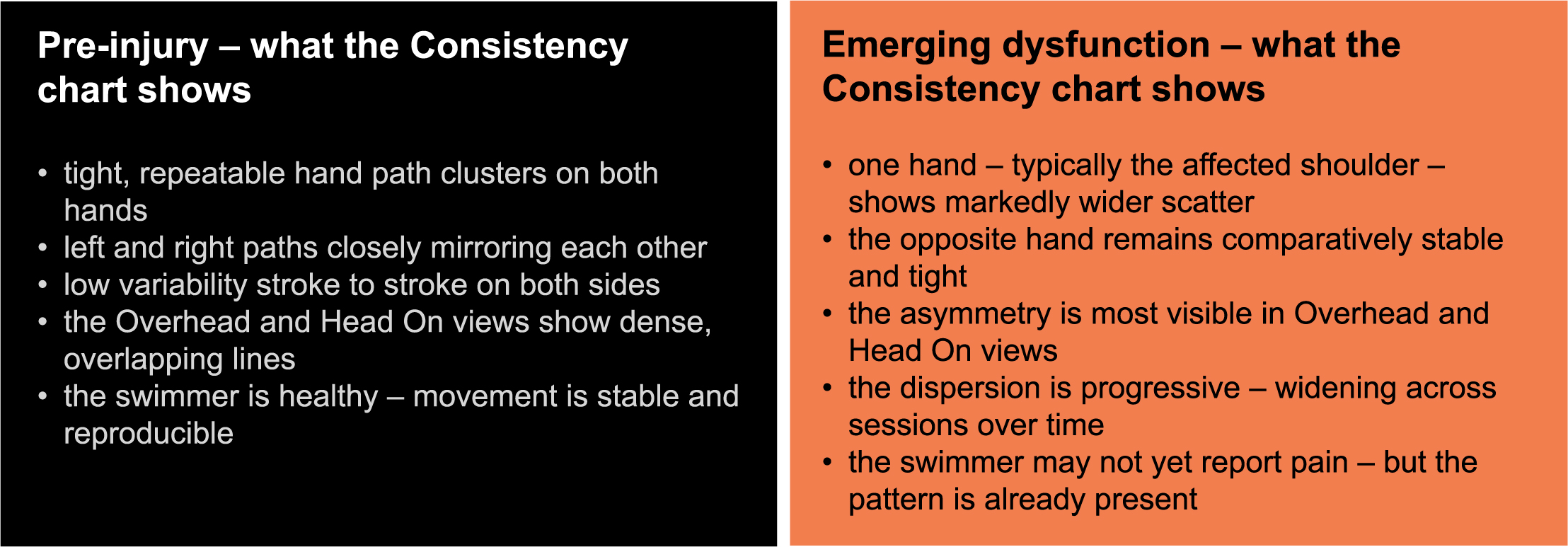
Error #12 is most clearly visible in the Consistency chart:
- Overhead view – the hand path spreading laterally, with strokes taking increasingly different routes
- Head On view – the entry and push arc becoming inconsistent on the affected side
- Side On view – depth variation increasing stroke to stroke on the affected hand
- the pattern typically worsens progressively across sessions – not just within a single session
- the affected side shows wide dispersion; the unaffected side remains tight and clustered
Why does the pattern appear?
The Consistency chart is measuring the repeatability of the hand path through the water. When repeatability deteriorates on one side, it means the shoulder driving that hand is no longer producing consistent movement. The question is: why?
In most cases of Error #12, the answer is some form of shoulder stress, overload, or early-stage dysfunction. The shoulder is not yet producing overt pain – or the swimmer is managing low-level discomfort without flagging it – but the joint and its supporting structures are no longer functioning with full stability. The movement becomes inconsistent because the system controlling it is under stress.
Common contributing factors to emerging shoulder dysfunction in swimmers:
- protective movement compensation – the body unconsciously alters the stroke to guard the affected shoulder
- pain avoidance mechanics – subtle movement pattern changes to avoid positions that provoke discomfort
- reduced shoulder stability – early rotator cuff overload reducing the shoulder's ability to maintain a consistent arc
- fatigue-induced neuromuscular breakdown – the affected shoulder losing positional control under load
- early-state rotator cuff overload or impingement patterns – the most common clinical presentation in competitive swimmers
What is common across all of these contributing factors is that the shoulder is compensating. The body is unconsciously altering the stroke to protect a structure that is under stress. And in doing so, it introduces variability – because compensation patterns are inherently less repeatable than well-established, stable motor patterns. The scatter in the Consistency chart is the fingerprint of a shoulder that is protecting itself.
The scatter is not random. It is the shoulder avoiding the positions that hurt – and doing so differently on every stroke, because avoidance patterns are never as consistent as healthy movement.
The three diagnostic criteria – when to act
Not every increase in consistency chart scatter on one side is Error #12. Increased variability can occur for many reasons – fatigue, technique breakdown, breathing mechanics, pacing changes. The specific diagnostic criteria for emerging shoulder dysfunction are three conditions that, when present together, warrant a clinical response rather than a coaching one.
Act on this pattern when ALL THREE of these are true:
- The deterioration is asymmetrical – one side widening significantly while the other remains stable.
- The deterioration is progressive – increasing across sessions over time, not just varying within a session.
- The deterioration is unrelated to pacing or stroke rate change – it appears regardless of effort level and is not explained by general fatigue.
When only one or two of these criteria are present, other explanations are more likely. A sudden increase in scatter on one side at race pace may be a technique breakdown under pressure. Gradual increase on both sides may be general fatigue or motor pattern degradation. But when all three criteria are present simultaneously – unilateral, progressive, pacing-independent – the probability of an emerging shoulder issue is high enough to warrant immediate action.
Why it matters – the injury prevention case
The pattern appears before pain
This is the most important fact about Error #12, and the most significant capability it represents in eo SwimBETTER. In many cases, the Consistency chart shows the deterioration pattern before the swimmer reports any pain. The body has already begun compensating – already begun protecting the shoulder – before the subjective experience of pain has crossed the threshold of awareness.
This window – between the appearance of the data pattern and the onset of reported pain – is the most valuable intervention opportunity in the entire injury prevention process. Act in this window and the outcome is load reduction, assessment, and a manageable rehabilitation pathway. Miss this window – continue training at full load through the deteriorating pattern – and the outcome is more likely to be an acute injury, a forced training stoppage, and a longer recovery.
Swimmer's shoulder is the most common overuse injury in the sport
Shoulder pain is estimated to affect between 40-60% of competitive swimmers at some point in their careers. The most common presentation – rotator cuff impingement and overload – typically develops gradually through the accumulation of repetitive stress at training volumes that the shoulder cannot adequately recover from between sessions.
The progression from overload to impingement to acute injury is usually slow. There is almost always a period of compensatory adaptation before overt pain – a period during which the movement patterns in the Consistency chart are already changing. eo SwimBETTER can detect that period. Traditional coaching observation and athlete self-reporting often cannot.
Training through the pattern accelerates the injury
One of the most important coaching principles for Error #12: do not attempt to correct the scatter with technique coaching. The scatter is a symptom of a shoulder that is compensating. Increasing technique focus or training volume at this point does not fix the underlying issue – it accelerates the load accumulation on a structure that is already struggling.
More repetitions of a compensated stroke pattern reinforce the compensation, increases the load on the affected structures, and shortens the time to acute injury. The correct response is to reduce load – not increase coaching intensity.
What to do about it – the response protocol
Error #12 has a specific, non-negotiable response protocol. Unlike every other error in this index, the response is not a technique correction sequence. It is a clinical management pathway.
Coaching response protocol when asymmetric deterioration appears
-
Confirm it is not pacing-related
Check whether the asymmetric dispersion appears at all effort levels or only under fatigue and high intensity. Pacing-related variability tends to affect both sides. Asymmetric dysfunction typically remains one-sided regardless of pace. -
Reduce load and stroke volume immediately
Do not continue training through the pattern. Reduce session volume and intensity while the assessment is conducted. Continuing at full load while compensation patterns are present accelerates the progression from emerging dysfunction to acute injury. -
Assess shoulder integrity – seek medical advice
This is not a technique coaching intervention. Refer the swimmer to a physiotherapist or sports medicine practitioner for a shoulder assessment. The data from eo SwimBETTER provides valuable context for that assessment – share the Consistency chart progression. -
Monitor consistency trends across sessions
Continue tracking the Consistency chart across sessions. Is the asymmetry stable, improving, or progressing? eoSwimBETTER serves as the objective monitoring tool through rehabilitation and return to training, confirming when movement patterns have stabilised before full load is resumed.
Using eo SwimBETTER for return-to-swim monitoring
Once medical clearance has been obtained and the swimmer begins returning to training, eo SwimBETTER becomes the objective monitoring tool for the return-to-swim process. The Consistency chart shows whether the affected side is regaining movement repeatability as load is reintroduced – or whether the compensation patterns are re-emerging as volume builds.
A return-to-swim plan that uses Consistency chart data at each load increment can confirm whether the shoulder is genuinely stable before the next stage of loading is introduced. This replaces subjective assessment – 'how does it feel?' – with objective measurement of whether the shoulder is actually producing repeatable movement.
The criteria for progression to full training load should include: the affected side's scatter returning to within a comparable range of the unaffected side, the pattern being stable across multiple sessions at each load level, and no progressive widening when load is increased. Medical clearance is a prerequisite, not a substitute, for this data-based return-to-swim confirmation.
A note on distinguishing Error #12 from Error #6 and Error #7
Three errors in this index involve the Consistency chart. Understanding how to distinguish them is essential for the right coaching response.
How to distinguish the three Consistency chart errors:
- Error #6 (Hand Position Inconsistency) – BOTH hands show wide scatter. The issue is neuromuscular repeatability or breathing mechanics. The correction is motor pattern work at reduced tempo.
- Error #7 (Hand Path Asymmetry) – BOTH hands have tight individual clusters, but they sit in DIFFERENT positions. The issue is structural asymmetry between left and right. The correction is breathing mechanics or trunk alignment work.
- Error #12 (Emerging Shoulder Dysfunction) – ONE hand shows wide, PROGRESSIVE scatter. The other remains stable and tight. The issue is not technique – it is shoulder health. The response is load reduction and medical assessment.
The bigger picture – a different kind of error
Error #12 is the final entry in the eo SwimBETTER Technical Error Index for a specific reason. The first eleven errors describe ways that technique breaks down and efficiency is lost. Error #12 describes something more fundamental: a swimmer whose body is signalling that it needs help – and a data system sophisticated enough to detect that signal before the swimmer is fully aware of it themselves.
This is one of the most significant capabilities that force measurement adds to swimming coaching. Not just performance optimisation. Not just technique refinement. But the ability to see, in objective data, a pattern that indicates a swimmer is moving toward injury – and to act on that information before the injury occurs.
Every other error in this index costs the swimmer speed. Error #12 can cost them the season. The data that identifies it is the most valuable data eo SwimBETTER produces.
The goal of the Technical Error Index has been to give coaches and athletes a framework for understanding what the data is telling them – quickly, clearly, and with enough depth to act on it confidently. Error #12 completes that framework with the most important message of all:
Sometimes the data isn't telling you to swim differently. It's telling you to stop, listen, and get the right people involved before it's too late.
Monitor the Consistency chart across sessions – not just within them.
When one side starts to scatter and the other doesn't – pay attention.
Reduce load. Seek assessment. Use the data to guide the return.
The data knew. Now you do too.
This completes the eo SwimBETTER Technical Error Index.
12 measurable freestyle errors. 12 data signatures. 12 pathways to improvement – or in the case of Error #12, to protection.
Download the full Technical Error Index to learn:
- the hidden technique patterns slowing swimmers down
- why they happen
- how to identify them in the data
- and what the evidence says about fixing them
Related topics: swimmer's shoulder injury prevention; shoulder dysfunction swimming; rotator cuff swimming; swimming injury detection; eo SwimBETTER; Consistency chart swimming; hand path consistency; return to swim data; swimming biomechanics; swim coaching injury prevention; shoulder impingement swimmers; swimming overuse injury; data driven coaching swimming; swimmer shoulder overload; early shoulder injury swimming; swim shoulder compensation; unilateral stroke deterioration; shoulder fatigue swimming; return to swim monitoring
Back