
Understanding Upward Force at End of Stroke
By Jaimie Fuller
The catch is established.
The pull drives forward.
The push phase builds – and then, at the very last moment, just before the hand exits the water...
The hand scoops upward. The palm tilts toward the surface. The final push – the last propulsive moment of the stroke before the arm recovers – redirects upward instead of backward. The effort that should have been the final drive of the stroke becomes a lift toward the surface.
No forward speed. No propulsion. Just energy spent pushing the water toward the surface at the moment it should have been pushing the swimmer toward the wall.
This is Error #11 in the eo SwimBETTER Technical Error Index – Upward Force at End of Stroke. It is the last in the series of directional force errors, and in some ways the most frustrating: a swimmer who has done most things right, only to lose propulsion at the final moment of every single stroke.
What is Upward Force at End of Stroke?
A complete freestyle stroke moves through four phases: entry and glide, catch, pull and push, and exit. Each phase has a specific role. The exit – the final moments as the hand completes the push and leaves the water – should contribute the final propulsive force of the stroke.
For this to happen, the hand needs to be vertically aligned as it exits – palm facing backward, fingers pointing toward the pool floor, driving water backward to the very end. What happens in Error #11 is that the hand rotates upward before exit – the wrist bends, the fingers angle toward the surface, and the palm tilts upward. Force that should have been propulsive is redirected upward, pushing against the underside of the water surface rather than backward through it.




The target for upward force is zero. Unlike downward force – which has a small transitional role – there is no beneficial function for upward force at the end of the stroke. It serves no propulsive purpose, contributes nothing to body position, and represents effort spent in the one direction that is entirely counterproductive to forward swimming.
Small values – under 3-4-% – are considered negligible and not worth intervening on. But when upward force climbs above this threshold, it is measurable speed being surrendered at the worst possible moment: the last propulsive opportunity of each stroke cycle.
In eo SwimBETTER, Upward Force at End of Stroke appears across two charts:
- Force Field chart: upward force % above the negligible threshold (target: 0%)
- Force vs Time chart: the vertical force waveform rising above the zero axis immediately before hand exit, visible as a spike in the right (purple) or left (orange) vertical force line
- the spike repeats on every affected stroke – not as a random event, but as a stable pattern
- may be asymmetric – more pronounced on one side, particularly if the issue is related to exit mechanics on the breathing arm
Why does it happen?
The hand is not vertically aligned at exit
The most direct cause. At the exit point – as the hand passes the hip and begins to leave the water – the wrist bends and the fingers angle upward rather than remaining pointed toward the pool floor. This is often a habitual movement pattern rather than a deliberate choice: the swimmer has developed a stroke exit that scoops upward, probably because it feels like a natural finish to the pull.
The upward scoop at exit is also sometimes the end point of a stroke that began with a dropped wrist or a broken catch. If the hand was never fully vertical during the pull, it may continue its downward-to-upward arc all the way through to the exit – arriving at the exit phase already angled in a direction that generates upward rather than backward force.
Premature arm recovery initiation
A second cause: the swimmer begins the arm recovery before the push phase is complete. As the shoulder lifts to start the recovery, it pulls the elbow – and then the wrist and hand – upward. The hand exits with an upward trajectory because the recovery has started too early, redirecting the final phase of the stroke from backward to upward.
This often develops as a pacing or rhythm response. At higher stroke rates or under fatigue, the recovery initiation creeps earlier – and the exit phase suffers as a consequence. The Force vs Time chart will show the upward force spike occurring earlier in the stroke cycle as stroke rate increases or fatigue builds, confirming that early recovery initiation is the driver.
An overcorrection to a dropped wrist
In some swimmers, the upward force at exit is the downstream consequence of having been coached to 'finish the stroke.' A swimmer who was previously exiting too early may have overcorrected – extending the push phase so far past the hip that the hand ends up above the hip line, angling upward as it exits. The intention was correct; the execution goes past the optimal exit point into a phase where upward force is the only mechanical outcome.
The stroke should end with the hand vertical and the palm facing backward – not with the palm facing the surface. The last push should go backward, not up.
The wrong fix – and the right one
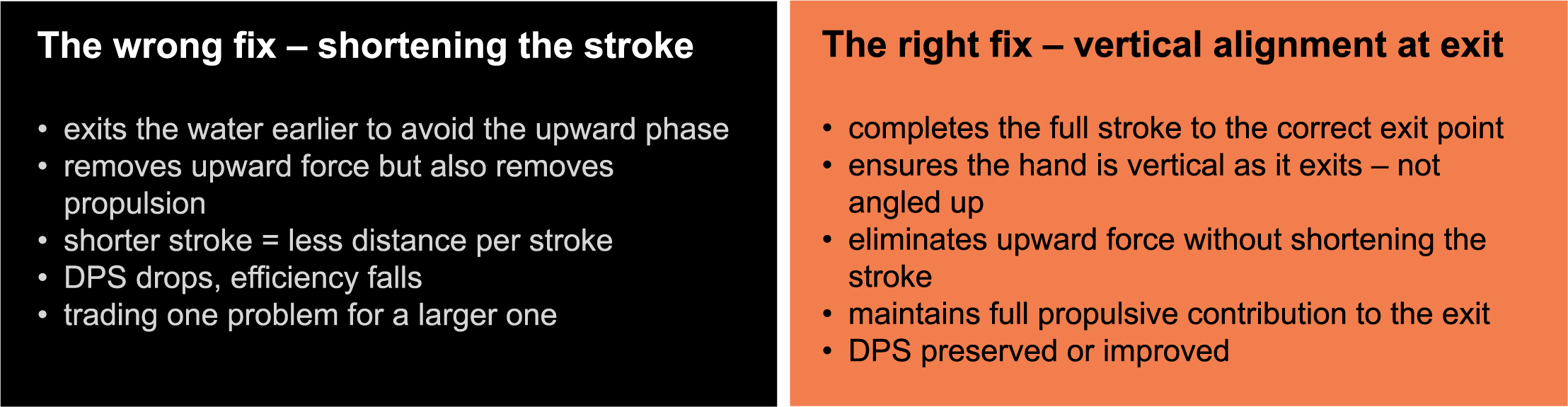
When coaches or swimmers identify upward force at the end of the stroke, there is a tempting but counterproductive instinct: shorten the stroke. Exit the water earlier – before the upward phase begins – and the upward force disappears.
This is a mistake. Shortening the stroke to avoid upward force trades one problem for a larger one. The exit point moves earlier, which means the final propulsive push is also cut short. Distance per stroke drops. The efficiency loss from the shortened stroke exceeds the efficiency gain from eliminating the upward force.

Why it matters
The last propulsive moment is wasted
Every stroke has a finite propulsive contribution. That contribution begins at the catch and ends at the exit. When the exit phase generates upward rather than backward force, the final portion of every stroke's propulsive arc is not just reduced – it is actively misdirected. The effort is real. The metabolic cost is real. The propulsion is not.
In practical terms: a swimmer with 10% upward force at exit is spending approximately one-tenth of their total force on an action that provides no forward speed and no useful body position effect whatsoever. That is a significant and entirely recoverable efficiency loss – on every stroke, of every lap, of every session and race.
Cumulative loss over distance
Like all per-stroke efficiency losses, upward force at exit compounds over distance. In a 400m freestyle event, a swimmer taking around 600 strokes who is losing 8-10% of their force to upward direction at exit is, in aggregate, swimming the race at a meaningful propulsive disadvantage. The metabolic cost of maintaining pace in that state is higher than it needs to be – and the pace that is sustainable is lower than it should be.
Rhythm and timing disruption
The upward scoop at exit also affects the timing of the arm recovery. When the hand exits with an upward trajectory, the recovery begins from a higher position – the elbow comes out of the water already elevated and the shoulder is already rotating. This can disrupt the timing of the opposite arm's catch, creating a cascade of timing disruptions across the stroke cycle that are difficult to identify without seeing the force data and hand path together.
Particularly visible under fatigue
As with several errors in this index, upward force at exit tends to worsen under fatigue. When the push phase becomes harder to sustain, the natural compensation is to shorten it – lifting the hand out of the water earlier, with an upward trajectory, rather than driving it through to a clean vertical exit. The Force vs Time chart will show the upward force spike becoming more pronounced in later laps of a distance swim, confirming the fatigue-related component.
What to do about it
Step 1: Confirm in both charts
Identify the upward force percentage in the Force Field chart. Then open the Force vs Time chart and look for the vertical force waveform right (purple) or left (orange) line rising above zero in the moments before hand exit on each stroke. Confirm the spike appears repeatedly rather than randomly. Note whether it is asymmetric between left and right, which may indicate a breathing-arm or exit-mechanics difference between sides.
Step 2: Identify the cause
Is the upward force present at all stroke rates, or does it worsen as tempo increases? If it appears or worsens at higher stroke rates, early recovery initiation is likely the driver – the shoulder is lifting to recover before the push is complete. If it is present consistently across all stroke rates, the cause is more likely to be habitual exit mechanics – the wrist bending upward as a fixed motor pattern.
Step 3: Focus on vertical alignment at exit
The primary coaching cue: as the hand approaches the hip and prepares to exit, keep the fingers pointing toward the pool floor. The palm should be facing backward – not upward. The exit should feel like the last backward push before the hand lifts clear, not an upward scoop that concludes the stroke.
A useful feel-based cue: imagine brushing the thumb along the outside of the thigh as the hand exits – maintaining contact with the thigh keeps the hand path vertical and prevents the upward scoop from initiating. This also ensures the stroke is completed to the correct exit point rather than exiting prematurely or extending too far past the hip.
Step 4: Address recovery timing if required
If early recovery initiation is the cause, the correction targets the shoulder. The shoulder should not begin to lift until the push phase is complete – until the hand has reached the hip and the vertical exit position. Drills that slow the recovery down – deep catch-up, single-arm with deliberate exit pause – allow the swimmer to feel the separation between a complete push phase and the recovery initiation that follows it.
Step 5: Build tempo gradually with data confirmation
Once vertical exit alignment is established at reduced stroke rate – confirmed by the disappearance of the upward force spike in the Force vs Time chart – stroke rate can be gradually increased. At each tempo increment, check whether the spike returns. If it does, the recovery is initiating too early at that speed. Back off the tempo slightly, consolidate the correct exit pattern, and rebuild from there.
Step 6: Check under fatigue
Because upward force at exit frequently worsens under fatigue, the correction should be stress-tested in race-pace sets and late in longer training swims. Review Force vs Time data from these sessions specifically. If the spike reappears significantly in later laps, the motor pattern for vertical exit has not yet embedded deeply enough to withstand fatigue – and further low-tempo reinforcement is needed before the improvement can be considered stable.
The bigger picture
Error #11 completes the directional force trilogy in the Technical Error Index: downward force wasted at the catch (Errors #3 and #4), lateral force wasted through the pull (Error #9), and now upward force wasted at the exit. Together, these three error types describe every direction in which propulsive effort can be misdirected – and eo SwimBETTER measures and quantifies all of them.
What makes Error #11 particularly notable is where it sits in the stroke cycle. This is not an error at the beginning of the stroke, where much of the coaching attention in swimming traditionally focuses. It is an error at the very end – in the final moments of the push phase, after everything else has been done correctly. A swimmer can have a clean catch, an efficient pull, and solid mid-stroke mechanics – and still be surrendering propulsion at the last moment on every stroke.
A stroke that starts well but finishes poorly is not a good stroke. Every part of the arc matters – including the last one.
The Force vs Time chart makes the exit spike visible. The Force Field chart quantifies it. And the correction – vertical alignment at exit, complete push before recovery – is one of the most directly actionable fixes in the entire Technical Error Index.
Complete the stroke. Keep the hand vertical. Drive backward to the very end.
The last push is still propulsion. Don't throw it away.
Find the exit spike in the Force vs Time chart.
Keep the fingers pointing down at exit.
Palm backward – not upward.
Complete the stroke. Every time.
Are you completing your stroke – or throwing the last push away?
Upward Force at End of Stroke is just one of 12 measurable freestyle errors identified through eo SwimBETTER data.
Download the full Technical Error Index to learn:
- the hidden technique patterns slowing swimmers down
- why they happen
- how to identify them in the data
- and what the evidence says about fixing them
Related topics: upward force swimming; freestyle stroke exit; hand exit freestyle; stroke finish swimming; push phase freestyle; eo SwimBETTER, Force vs Time swimming; Force Field chart; swimming force measurement; freestyle propulsion; swim stroke efficiency; swimming biomechanics; distance per stroke swimming; freestyle stroke finish; freestyle push phase; swimming hand exit; incomplete freestyle finish; swim stroke exit mechanics
Back