
Understanding Broken Wrist at Catch (Pitch Fault)
By Jaimie Fuller
A kayak paddle works because the blade is flat and perpendicular to the water.
The face of the blade catches the water cleanly. No angle. No tilt. Full surface area.
Now imagine the blade is bent at the shaft – angled downward at fifteen degrees.
Every stroke, the blade face is no longer perpendicular. It's angled. Some of the force goes through the water rather than against it. The paddle slips. The boat moves less than it should. And the paddler works just as hard – often harder – to compensate for the fact that their paddle is never quite right.
This is precisely what happens when a swimmer swims with a broken wrist at catch. The paddle – the hand and forearm – is bent at the wrist joint. The fingers angle downward rather than pointing toward the pool floor. The full face of the paddle never squares up to the water. And the propulsive surface area is permanently reduced on every stroke.
This is Error #10 in the eo SwimBETTER Technical Error Index – a pitch fault that sits at the catch phase and persists through the pull, silently reducing efficiency with every stroke. It is particularly damaging for distance swimmers, and it is one of the errors most clearly revealed by the relationship between two specific data signals in the Hand Path & Force chart.
What is Broken Wrist at Catch?
In an efficient catch, the wrist undergoes a specific rotation as the arm transitions from glide to pull. The hand begins extended forward, fingers angled slightly downward. As the catch begins, the elbow rises and the wrist rotates so the fingers point directly toward the pool floor and the palm faces squarely backward. This is the moment of maximum propulsive surface area – the full face of the hand and forearm aligned perpendicular to the direction of travel.
A broken wrist at catch means this rotation is incomplete or absent. The wrist drops – the fingers angle downward and the wrist bends rather than the elbow lifting – and the hand never reaches a vertical position. The palm, instead of facing squarely backward, faces downward and backward. The paddle is bent.
This is a pitch fault – pitch being the vertical angle of the hand at the fingertips. In correct catch mechanics, pitch transitions from slightly downward (glide) to neutral or slightly upward (vertical hand position at catch). In a broken wrist fault, pitch remains persistently downward throughout the catch and into the pull phase.
In eo SwimBETTER, Broken Wrist at Catch appears in the Hand Path & Force chart as:
- downward force and propulsive force peaking simultaneously – rather than downward force peaking earlier
- persistent downward pitch visible in the hand path side view – the hand staying angled throughout the pull rather than becoming vertical
- reduced peak propulsive force compared to what the swimmer's total force output suggests is possible
- the propulsive peak is lower and broader than in a clean catch – force spread over a longer period at reduced intensity
Reading the data – the timing signal
The clearest sign of Error #10 is not just the presence of downward force during the pull – that is expected to some degree – but the timing relationship between the downward force peak and the propulsive force peak.
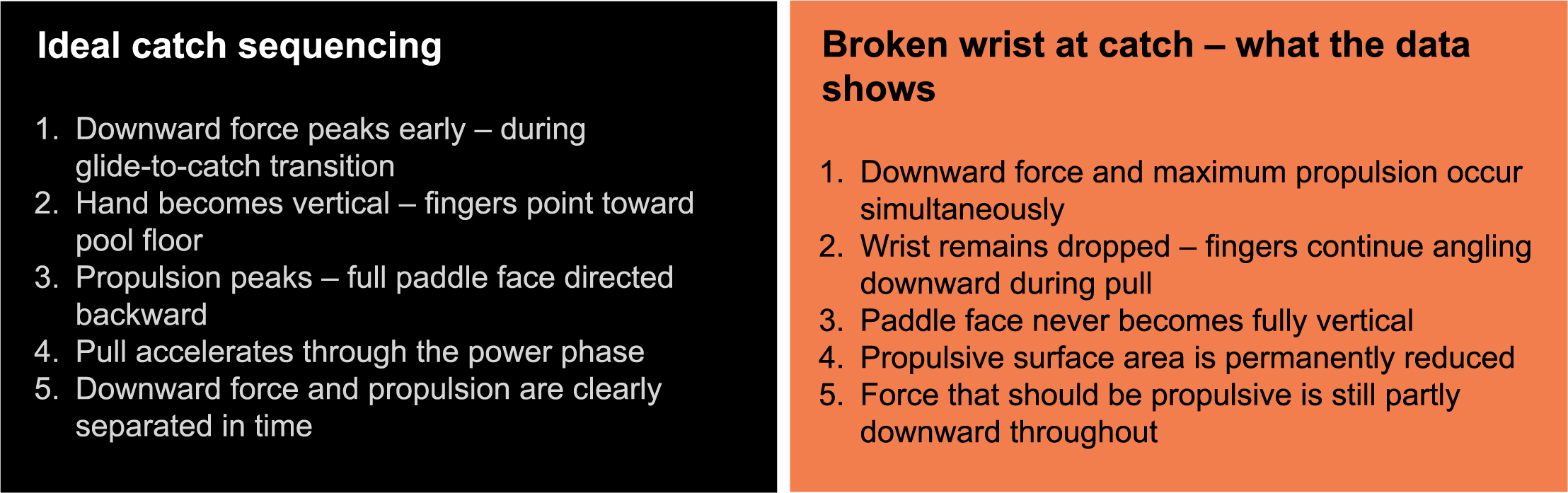
In a correct catch, these two peaks are separated in time. Downward force peaks early – during the transition from glide to catch, as the hand angles downward briefly before becoming vertical. Then, as the hand becomes vertical and the palm faces backward, the downward force drops and propulsive force peaks. The two are sequential, not simultaneous.
In a broken wrist catch, the two peaks coincide. Maximum downward force and maximum propulsive force occur at the same moment. The data shows that the hand never separated the two phases – it never completed the rotation to a vertical position before the pull began. The paddle bent its way through the catch and pulled with a permanently angled face.
When downward force and propulsive force peak simultaneously, the hand never became vertical. The catch phase was skipped – and the pull was performed with a bent paddle throughout.
This timing signal is one of the most precise diagnostic indicators in the entire Technical Error Index. It doesn't just confirm that downward force is elevated – Error #3 does that. It identifies a specific sequencing failure at the catch that is distinct from a general pressing-down problem and requires a targeted correction at wrist pitch specifically.

How Error #10 differs from Error #3
Both Error #3 (Excessive Downward Force) and Error #10 involve elevated downward force. But they are different errors with different causes, different data signatures, and different corrections.
Error #3 vs Error #10 – the key distinction:
Error #3 is a force direction problem – the hand presses down throughout the catch and pull because pitch and forearm orientation are incorrect. The correction focuses on changing the direction of force. Error #10 is a sequencing and pitch problem – the wrist bends rather than rotating, so the hand never achieves a vertical position and the two force phases (downward and propulsive) are never separated. The correction focuses specifically on wrist pitch and the rotation to a vertical hand position before the pull begins. In Error #3, downward force is high but propulsion may still peak separately. In Error #10, they peak together – the clearest marker of this specific fault.
Why does it happen?
Incomplete wrist rotation to vertical
The most direct cause: the wrist simply doesn't complete the rotation needed to bring the hand to a vertical position before the pull begins. The swimmer initiates the pull too early – before the hand has squared up – or lacks the proprioceptive awareness to feel when the hand is and isn't vertical. The pull starts with the paddle still angled, and continues with it that way.
This is especially common in swimmers who have been taught to 'feel the water early' at the catch. The pursuit of early catch sensation can lead to initiating the pull before the hand has completed its rotation to vertical – trading propulsive surface area for an earlier application of force. The data consistently shows this is a poor trade.
Wrist collapse rather than elbow lift
A broken wrist and a dropped elbow are related but distinct faults. A dropped elbow typically causes the hand to press downward from above – the whole arm is in the wrong position. A broken wrist occurs when the elbow position is acceptable but the wrist bends rather than the hand rotating. The elbow may be reasonably high, but the wrist drops below the elbow line, angling the fingers downward and preventing the hand from ever becoming truly vertical.
The distinction matters for correction. If the elbow is dropped, fixing the elbow fixes the wrist. If the elbow is reasonable but the wrist is bent, the correction must target the wrist specifically – the rotation of the hand to a vertical position independent of elbow position.
Particularly pronounced in distance swimmers
Error #10 appears across all freestyle swimmers, but its impact is disproportionately large for distance swimmers – and it shows up more frequently in the data for this group as well. The reason is straightforward: distance swimmers rely on the early vertical forearm and a clean, efficient catch to generate propulsion across hundreds of strokes. Even a small reduction in propulsive surface area at the catch – maintained across 800, 1500, or more metres – accumulates into a significant efficiency deficit.
Sprint swimmers, with their shorter events and higher reliance on raw force, are generally less affected by small catch efficiency losses. Distance swimmers cannot afford to give away even a fraction of their propulsive surface area on every stroke.
Why it matters
Permanently reduced propulsive surface area
The hand and forearm together form the swimmer's paddle. The effectiveness of that paddle depends critically on the angle at which it faces the water. A hand that is angled downward – rather than vertical – presents a reduced effective surface area to the backward direction of force. Instead of the full face of the hand driving water backward, a portion of the force goes downward and only the remainder goes backward.
Unlike an error that creates a momentary propulsion loss (Error #8) or a phase-specific force waste (Errors #3 and #4), a broken wrist at catch reduces propulsive surface area throughout the pull phase. It is a sustained, continuous efficiency reduction rather than a phase-specific fault. Every metre of every stroke is affected.
The catch phase is never properly established
In swimming, the catch is the foundation of the pull. It is the moment when the paddle anchors in the water and the body begins to drive past it. A broken wrist means the anchor is never properly set. The hand slips – not sideways as in a yaw fault, not from a dropped elbow as in Error #4, but because the paddle face is permanently tilted and never achieves the perpendicular orientation needed for maximum grip on the water.
The body does move forward. But it moves forward less efficiently than it should – because the anchor that was supposed to hold it in place while the body drove past was never fully set.
The distance efficiency tax
In a 1500m freestyle event, a competitive swimmer might take 900 to 1,100 strokes. If each stroke's propulsive surface area is reduced by even 10-15% due to a broken wrist pitch, the cumulative propulsion deficit across the race is enormous. The swimmer either swims slower for the same effort, or works harder to maintain pace – paying an efficiency tax on every single stroke of every single race.
This is why Error #10 is listed as particularly critical in distance swimmers. The pitch fault is not more severe in distance swimmers – but its consequences are multiplied by the volume of strokes over which it operates.
What to do about it
Step 1: Confirm the timing signal in the data
Use the Hand Path & Force chart. Are maximum downward force and maximum propulsive force occurring simultaneously? If yes, the wrist is not completing its rotation to vertical before the pull begins. This is the definitive confirmation of Error #10 and sets the correction focus on wrist pitch specifically rather than general downward force reduction.
Step 2: Establish what vertical feels like
Many swimmers with this error have never developed strong proprioceptive awareness of when their hand is and isn't vertical. Before any drill work, spend time helping the swimmer feel the difference between a bent wrist (fingers angling downward, palm facing down and back) and a vertical hand (fingers pointing toward the pool floor, palm facing squarely backward).
Out-of-water exercises – standing with the arm extended, rotating the wrist to a vertical position and feeling the difference in palm orientation – can be surprisingly effective for building this awareness before it is needed in the water. The swimmer needs to know what they are aiming for before they can reliably produce it.
Step 3: Focus on fingers pointing down before the pull begins
The coaching cue for this error is specific: at the catch, the fingers should point directly toward the pool floor – not diagonally, not at an angle, but straight down – before the pull begins. This is the signal that the wrist has completed its rotation and the hand is vertical.
A useful secondary cue: show the full face of the hand to the back of the pool. If the palm is facing any direction other than directly backward at the catch point, the wrist has not fully rotated. The swimmer can check this with underwater video, but the feel of the water pressing squarely against the palm – rather than against the angled palm and fingers – is also a strong proprioceptive signal once the swimmer learns to identify it.
Step 4: Slow drills with deliberate catch focus
Single-arm swimming with deliberate catch pause is one of the most effective drills for this error. The swimmer extends the arm forward, pauses briefly at the catch point, consciously rotates the wrist to a vertical position – confirming the fingers are pointing down and palm faces back – and then initiates the pull. The pause exaggerates the separation between the downward-force phase and the propulsive phase, training the sequencing that Error #10 is missing.
Catch-up drill and fingertip-drag entry both reinforce slow, deliberate entry and catch mechanics. At reduced stroke rate, the swimmer has time to feel the catch position and confirm it before beginning the pull.
Step 5: Confirm the timing separation in post-intervention data
After intervention, return to the Hand Path & Force chart. Has the timing relationship between the two force peaks changed? Is the downward force peak now preceding the propulsive peak – rather than coinciding with it? This temporal separation is the data confirmation that the wrist is completing its rotation to vertical before the pull begins.
This is one of the most satisfying corrections to track in eo SwimBETTER data, because the timing shift is clear and unambiguous. The two peaks move apart in time as the catch improves – a precise, measurable marker of exactly the sequencing change the intervention was designed to produce.
The bigger picture
Error #10 represents a specific and elegant application of the paddle concept. The whole premise of efficient swimming is that the paddle anchors squarely in the water and the body drives past it. A broken wrist means the paddle never squares up – the anchor is set at an angle, the grip is reduced, and every stroke produces less forward drive than it should.
What makes this error distinctive within the Technical Error Index is its precision. It is not a general catch problem. It is not simply elevated downward force. It is a specific failure to complete the wrist rotation that takes the hand from angled to vertical – a failure visible in the simultaneous peaking of two force signals that should always be separated in time.
The Hand Path & Force chart doesn't just show you there is a problem at the catch. It shows you exactly when the hand failed to become what it needed to be – a vertical, backward-facing paddle with the full surface area engaged.
For distance swimmers in particular, correcting a broken wrist at catch is one of the highest-return technique investments available. The improvement applies to every stroke of every length of every session and race. The efficiency gain is sustained, cumulative, and directly measurable.
Find the vertical position. Feel the full face of the paddle. And confirm in the data that the two peaks have separated – because when they do, the catch has finally been established the way it was always meant to be.
Find the timing signal.
Rotate the wrist. Point the fingers down.
Let the paddle face backward – fully.
Watch the two peaks separate in the data.
Does your paddle ever truly face backward?
Broken Wrist at Catch is just one of 12 measurable freestyle errors identified through eo SwimBETTER data.
Download the full Technical Error Index to learn:
- the hidden technique patterns slowing swimmers down
- why they happen
- how to identify them in the data
- and what the evidence says about fixing them
Related topics: broken wrist at catch swimming; freestyle pitch fault; wrist position catch freestyle; hand pitch swimming; catch mechanics freestyle; early vertical forearm; eo SwimBETTER; Hand Path & Force chart; swimming force measurement; distance swimming efficiency; freestyle technique analysis; swimming biomechanics; swim catch drill; broken wrist freestyle; swimming wrist position; bent wrist catch swimming; freestyle catch timing; vertical forearm swimming; swim catch sequencing
Back